Advertisements
Advertisements
Question
non-stoichiometric defects?
Advertisements
Solution
The defect shown by NaCl in non-stoichiometric defect is metal excess defect due to anionic vacancies which is known as F-centre.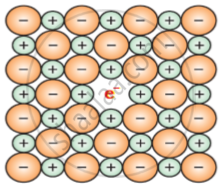
APPEARS IN
RELATED QUESTIONS
Explain the following term with a suitable example:
Interstitials
Examine the given defective crystal:
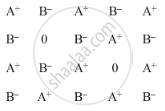
Answer the following questions :
(i) What type of stoichiometric defect is shown by the crystal?
(ii) How is the density of the crystal affected by this defect?
(iii) What type of ionic substances show such defect?
Point defect is also known as ____________.
Which is not correct about the Schottky defects?
Assertion: No compound has both Schottky and Frenkel defects.
Reason: Both defects change the density of the solid.
Silver halides generally show:
Which of the following point defects are shown by AgBr(s) crystals?
- Schottky defect
- Frenkel defect
- Metal excess defect
- Metal deficiency defect
Which of the following defects decrease the density?
(i) Interstitial defect
(ii) Vacancy defect
(iii) Frankel defect
(iv) Schottky defect
Why is FeO (s) not formed in stoichiometric composition?
Which type of ‘defect’ has the presence of cations in the interstitial sites?
