Advertisements
Advertisements
Question
Schottky defect is observed in crystals when ______.
Options
some cations move from their lattice site to interstitial sites.
equal number of cations and anions are missing from the lattice.
some lattice sites are occupied by electrons.
some impurity is present in the lattice.
Advertisements
Solution
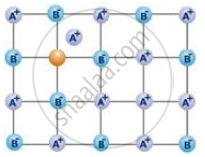
Schottky defect is observed in crystals when equal number of cations and anions are missing from the lattice.
Explanation:
| Defect | Definition | Type of solid |
Effect of defect on density of substance |
Structure of crystal (with defect) |
| Schottky defect |
A crystal is said to have Schottky defect if equal number of cations and anions are missing from their normal lattice site there by creating vacancies or holes. |
Ionic solid |
Decreases |  Schottky defect in a crystal |
APPEARS IN
RELATED QUESTIONS
Examine the given defective crystal:

Answer the following questions :
(i) What type of stoichiometric defect is shown by the crystal?
(ii) How is the density of the crystal affected by this defect?
(iii) What type of ionic substances show such defect?
non-stoichiometric defects?
Answer the following question.
What type of stoichiometric defect is shown by ZnS and why?
Ionic solids containing large differences in sizes of ions show ____________.
Defect shown by non-ionic solids is ____________.
Defects in solids can be studied using
Dislocation defect is also known as ____________.
The following diagram shows:
Assertion: No compound has both Schottky and Frenkel defects.
Reason: Both defects change the density of the solid.
Which of the following crystals does not exhibit Frenkel defect?
Silver halides generally show:
What is the effect of Frenkel defect on the density of ionic solids?
In a Schottky defect ____________.
Which of the following defects decrease the density?
(i) Interstitial defect
(ii) Vacancy defect
(iii) Frankel defect
(iv) Schottky defect
Given below are two statements, one is labelled as Assertion (A) and the other is labelled as Reason (R):
Assertion: In any ionic solid (MX) with Schottky defects, the number of positive and negative ions are same.
Reason: Equal number of cation and anion vacancies are present.
If NaCl is doped with 10–4 mole percent of SrCl2 the concentration of cation vacancies will be
Schottky defect is noticed in ______
The incorrect statement about the imperfections in solids is ______.
Which type of ‘defect’ has the presence of cations in the interstitial sites?
