Advertisements
Advertisements
प्रश्न
non-stoichiometric defects?
Advertisements
उत्तर
The defect shown by NaCl in non-stoichiometric defect is metal excess defect due to anionic vacancies which is known as F-centre.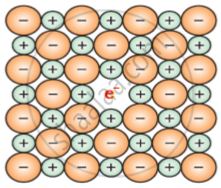
APPEARS IN
संबंधित प्रश्न
Explain the following term with suitable examples:
Frenkel defect
Give reasons : In stoichiometric defects, NaCl exhibits Schottky defect and not Frenkel defect.
Ionic solids containing large differences in sizes of ions show ____________.
Frenkel defects are not found in alkali metal halides because ____________.
The radius of Cs+ is 169 pm and Cl− is 181 pm. The radius ratio is ____________.
Type of stoichiometric defect shown by ZnS is ____________.
Which is not correct about the Schottky defects?
Which of the following statements are not true?
(i) Vacancy defect results in a decrease in the density of the substance.
(ii) Interstitial defects results in an increase in the density of the substance.
(iii) Impurity defect has no effect on the density of the substance.
(iv) Frankel defect results in an increase in the density of the substance.
Match the defects given in Column I with the statements in given Column II.
| Column I | Column II |
| (i) Simple vacancy defect | (a) shown by non-ionic solids and increases density of the solid. |
| (ii) Simple interstitial defect | (b) shown by ionic solids and decreases density of the solid. |
| (iii) Frenkel defect | (c) shown by non ionic solids and density of the solid decreases. |
| (iv) Schottky defect | (d) shown by ionic solids and density of the solid remains the same. |
Which type of ‘defect’ has the presence of cations in the interstitial sites?
