Advertisements
Advertisements
Question
Name the two types of spherical mirrors. What type of mirror is represented by the:
back side of a shining steel spoon?
Advertisements
Solution
The types of spherical mirrors represented by the
back side of a shining steel spoon is convex mirror, and
APPEARS IN
RELATED QUESTIONS
A student focused the Sun rays using an optical device 'X' on a screen S as shown.
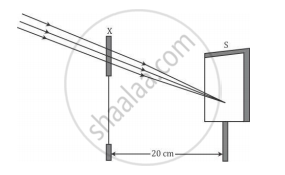
From this it may be concluded that the device 'X' is a (select the correct option)
(A) Convex lens of focal length 10 cm.
(B) Convex lens of radius of curvature 20 cm.
(C) Convex lens of focal length 20 cm.
(D) Concave mirror of focal length 20 cm.
An image which can be obtained on a screen is called a ______ image.
What is a virtual image?
What happens when a ray of light falls normally (or perpendiculary) on the surface of a plane mirror?
What is the name of the phenomenon in which the right side of an object appears to be the left side of the image in a plane mirror?
A coin placed at the bottom of a vessel appears to be raised when water is poured in the vessel.
An optical device has been given to a student and he determines its focal length by focusing the image of the sun on a screen placed 24 cm from the device on the same side as the sun. Select the correct statement about the device.
(A) Convex mirror of focal length 12 cm
(B) Convex lens of focal length 24 cm
(C) Concave mirror of focal length 24 cm
(D) Convex lens of focal length 12 cm
Three mirrors are created from a single sphere. Which of the following - pole, centre of curvature, radius of curvature, principal axis - will be common to them and which will not be common?
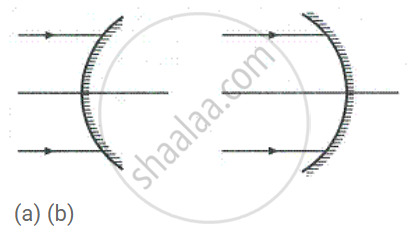
Name the mirrors shown in Figure (a) and (b).
State the two convenient rays that are chosen to construct the image by a spherical mirror for a given object? Explain your answer with the help of suitable ray diagrams.
When an object of height 1 cm is kept at a distance 4 cm from a concave mirror, its erect image of height 1.5 cm is formed at a distance 6 cm behind the mirror. Find the focal length of mirror, by drawing.
An object of height 2 cm is placed at a distance of 20 cm in front of a concave mirror of a focal length of 12 cm. Find the position, size, and nature of the image.
Select the correct option:
A concave mirror is made by cutting a portion of a hollow glass sphere of radius 30 cm. The focal length of the concave mirror is:
Select the correct option:
Which mirror is used in periscope?
Is real image always inverted?
Define linear magnification produced by a mirror?
The following Figure shows a concave mirror MM' on which a ray of light incident from a point P gets reflected to meet the principle axis at O.
(a) Find, by construction, the position of the centre of curvature of the concave mirror.
(b) Write down the value for the radius of curvature of the mirror.
(c) Calculate the focal length of the mirror.
(d ) Which relation is used in deducing the focal length from the radius of curvature?
If the focal length of a spherical mirror is 10 cm, what is the value of its radius of curvature?
Geometric centre of the spherical mirror is ______.
The distance from the center of curvature of the mirror to the pole is called the focal length of the mirror.
