Advertisements
Advertisements
Question
Name three main characteristics of an heating element.
Advertisements
Solution
The three main characteristics of an heating element are:
(i) It should have a high resistance so that a major amount of electric energy is converted into heat energy.
(ii) It should not get oxidised easily up to a temperature of 1000°C.
(iii) It should have a high melting point and a low thermal Expansion so that it does not get loosened on getting heated.
RELATED QUESTIONS
Two lamps, one rated 100 W at 220 V, and the other 60 W at 220 V, are connected in parallel to electric mains supply. What current is drawn from the line if the supply voltage is 220 V?
An electric heater of resistance 8 Ω takes a current of 15 A from the mains supply line. Calculate the rate at which heat is developed in the heater.
Distinguish between kilowatt and kilowatt-hour.
A servo voltage stabiliser restricts the voltage output to 220 V ± 1%. If an electric bulb rated at 220 V, 100 W is connected to it, what will be the minimum and maximum power consumed by it?
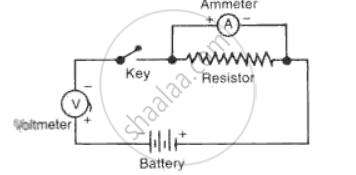
What is wrong with the circuit diagram (Fig. 34)? Carefully check the symbols and assign proper positive and negative signs to them.
A simple electric circuit has a 30 V battery and a resistor ot 60 o. What will be the current in the circuit? The resistance of the oonnecting wires is negligible.
Mention three uses of the carbon arc.
An electric filament lamp is connected to a supply of voltage higher than the recommended value. Give reasons, why compared with a normal performance, the lamp emits a brighter light and its life is shortened.
‘The current rating of a fuse is 5A’. Comment on this statement.
Two bulbs are rated: bulb A 100W, 120 V bulb B 10 W, 120 V. If both are connected across a 120V supply, which bulb will consume more energy, When in parallel? Also calculate the current through each bulb in the above cases.
