Advertisements
Advertisements
Question
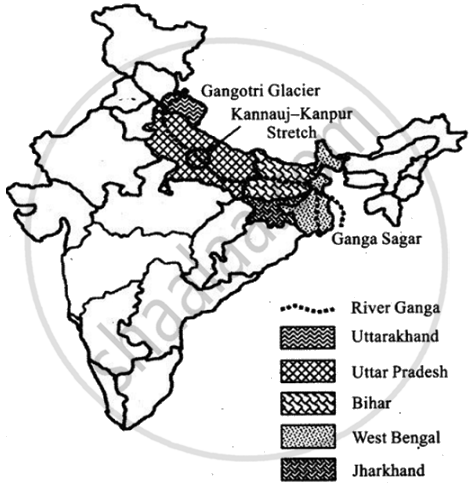
Name the states involved in Ganga action plan.
Advertisements
Solution
Uttarakhand, Uttar Pradesh, Bihar, West Bengal and Jharkhand.
APPEARS IN
RELATED QUESTIONS
Distinguish between the roles of flocs and anaerobic sludge digesters in sewage treatments.
Explain the process of sewage water treatment before it can be discharged into natural water bodies.
What is the key difference between primary and secondary sewage treatment?
Describe how do 'flocs' and 'activated sludge' help in Sewage Treatment.
What is primary treatment of sewage?
Name the chamber in which the suspended objects are filtered and removed during sewage treatment?
Small part of activated sludge is passed back into primary sedimentation tank.
If the above statement is correct then rewrite as it is and in case it is incorrect then reframe it.
In the process of biogas production which of the following anaerobic bacteria are used?
Small part of activated sludge is passed back into ______ and major part is pumped into large tanks called ______.
Identify the INCORRECT statement with respect to sewage treatment.
During sewage, treatment biogas is produced wits which include:
BOD of waste water is estimated by measuring the amount of ______.
What is the group of bacteria found in both the rumen of cattle and shidge of sewage treatment?
What would happen if a large volume of untreated sewage is discharged into a river?
Study the given diagram of the Sewage Treatment Plant (S.T.P.) and answer the question that follows:
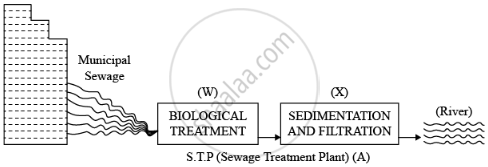
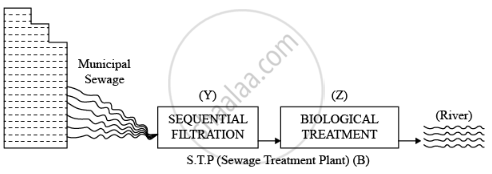
- Which one of the two 'S.T.P.' (A) or (B) will be more effective in treating the human excreta in municipal waste?
- Write the steps followed in carrying the treatment of the sewage in step (Z), once the BOD of sewage is reduced significantly till it is passed on to the "anaerobic sludge digesters".
During primary sewage treatment, floating debris is separated by which physical process?
In a sewage treatment plant, grit comprising soil and small pebbles is removed during which stage and process?
By what percentage does the decomposition of organic matter by aerobic bacteria in aeration tanks typically lower the BOD during secondary treatment?
