Advertisements
Advertisements
Question
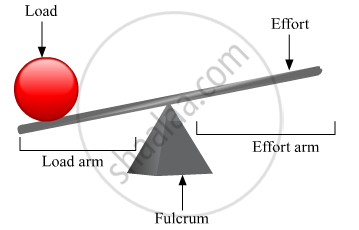
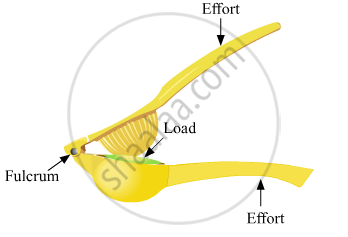
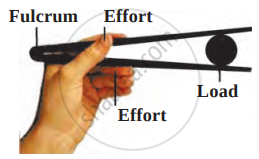
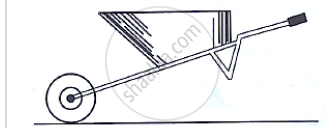
Name the levers mentioned in the following passage. Identify the fulcrum, load, and effort of each and say which type of lever it is.
Ravi and Savita sit on a seesaw in a garden. In the meantime, a gardener is trimming trees in the garden. He puts the leaves and other garbage in the wheelbarrow. Later, Ravi gets thirsty and he buys lemon sherbet. The sherbet seller cuts the lemon and squeezes it using a lemon squeezer. He puts small pieces of ice in the glass with the help of the tongs.
Advertisements
Solution
Levers mentioned in the passage are:
- Sea-saw: It is a first-order lever.
- Wheelbarrow: It is a second-order lever.

- Lemon squeezer: It is a third-order lever.
- Tongs: It is a fourth-order lever.
RELATED QUESTIONS
State whether the following statement is True or False.
In an ideal machine, work done on load is equal to the work done by effort.
State if the following statement is true or false. Correct the statement if it is false.
There are four types of simple machines.
State if the following statement is true or false. Correct the statement if it is false.
Work done by a machine is always more than the work done on a machine.
Derive the relationship between mechanical advantage, velocity ratio and efficiency of a machine.
The diagram below shows a wheel barrow. Mark position of fulcrum F and draw arrows to show the directions of load L and effort E. What class of lever is the whell barrow? Give one more example of the same class of lever.
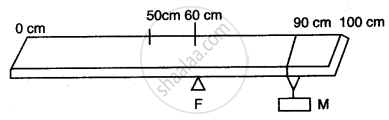
A uniform metre scale is kept in equilibrium when supported at the 60 cm mark and a mass M is suspended from the 90 cm mark as shown in the figure. State with reasons, whether the weight of the scale is greater than, less than or equal to the weight of mass M.
Classify the following as a lever, a pulley and an inclined plane:
An opener
Which machine will you use to do the following work? Write their type.
To draw water from a well.
Which machine will you use to do the following work? Write their type.
To hold a papad for roasting it.
A pair of scissors is a _____ multiplier.
