Advertisements
Advertisements
प्रश्न
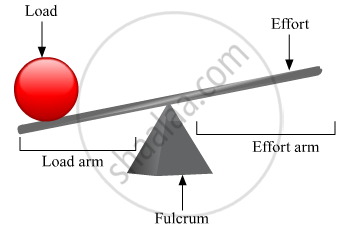
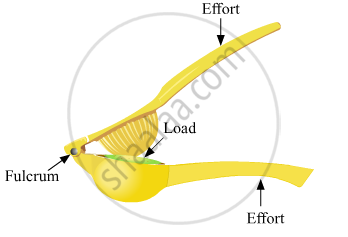
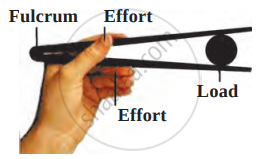
Name the levers mentioned in the following passage. Identify the fulcrum, load, and effort of each and say which type of lever it is.
Ravi and Savita sit on a seesaw in a garden. In the meantime, a gardener is trimming trees in the garden. He puts the leaves and other garbage in the wheelbarrow. Later, Ravi gets thirsty and he buys lemon sherbet. The sherbet seller cuts the lemon and squeezes it using a lemon squeezer. He puts small pieces of ice in the glass with the help of the tongs.
Advertisements
उत्तर
Levers mentioned in the passage are:
- Sea-saw: It is a first-order lever.
- Wheelbarrow: It is a second-order lever.

- Lemon squeezer: It is a third-order lever.
- Tongs: It is a fourth-order lever.
संबंधित प्रश्न
State whether the following statement is True or False.
A machine performs work by itself.
State whether the following statement is True or False.
In an ideal machine, work done on load is equal to the work done by effort.
Select the correct alternative:
For an ideal machine, the efficiency is
State if the following statement is true or false. Correct the statement if it is false.
Work done by a machine is always more than the work done on a machine.
What do you understand by a simple machine?
Give an example of the following uses of a machine:
to obtain gain in speed
Fig show a system of four pulleys. The upper two pulleys are fixed and the lower two are movable.
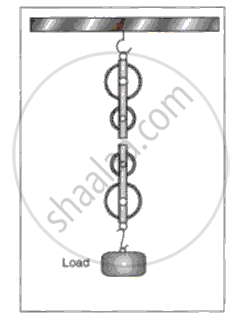
(i) Draw a string around the pulleys. Also show the place and direction in which the effort is applied.
(ii) What is the velocity ratio of the system?
(iii) What is the mechanical advantage of the system?
(iv) What assumption do you make in arriving at your answer in part (iii)?
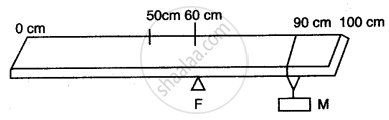
A uniform metre scale is kept in equilibrium when supported at the 60 cm mark and a mass M is suspended from the 90 cm mark as shown in the figure. State with reasons, whether the weight of the scale is greater than, less than or equal to the weight of mass M.
Why is this so traveller’s bags have wheels?
Simple machines usually exchange a larger force to move a heavy object.
