Advertisements
Advertisements
Question
State whether the following statement is True or False.
In an ideal machine, work done on load is equal to the work done by effort.
Options
True
False
Advertisements
Solution
True.
APPEARS IN
RELATED QUESTIONS
State whether the following statement is True or False.
A machine performs work by itself.
Select the correct alternative:
For an ideal machine, the efficiency is
Answer the following in short.
Mention any two methods by which we can take care of machines.
What is the purpose of a jack in lifting a car by it?
Why is a machine not 100% efficient?
The correct relationship between the mechanical advantage (M.A.), the velocity ratio (V.R.) and the efficiency (n) is ______.
Write the relation between mechanical advantage, velocity ratio and efficiency.
Fig. shows a spade. It is being used to lift soil weighing 30N from the ground.
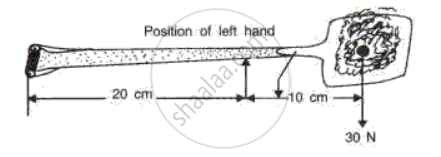
(a) Mark the direction of the least force on the handle necessary to keep the spade balanced.
(b) Calculate the least force on the handle necessary to keep the spade balanced (the weight of the spade is negligible).
(c) If the left hand was move towards the soil on the spade, would the force on the handle necessary to keep the soil balance the greater or less? Give a reason for your answer.
(d) To which class of lever does the spade belong?
Classify the following as a lever, a pulley and an inclined plane:
A wedge
Name a machine for each of the following uses:
- to multiply the force,
- to change the point of application of force,
- to change the direction of force,
- to obtain the gain in speed.
