Advertisements
Advertisements
Question
Multiple Choice Question
In metal activity series the more reactive metals are at
Options
top
bottom
middle
none
Advertisements
Solution
top
APPEARS IN
RELATED QUESTIONS
Indicate which of the following statement is true and which is false:
Nitric acid cannot be used to prepare hydrogen by its action on active metals.
Give reason for the following:
Nitric acid not used for the preparation of hydrogen gas?
Name the following:
A metal which liberates hydrogen only when steam is passed over red hot metal.
Name the chemicals required to prepare hydrogen gas in the laboratory.
Draw a neat and well-labelled diagram for the laboratory preparation of hydrogen.
How would you show that hydrogen is a non-supporter of combustion?
FILL IN THE BLANK
Sodium liberates hydrogen when treated with cold .............
FILL IN THE BLANK
........................ zinc is preferred over pure zinc in the laboratory preparation of hydrogen.
TRUE \ FALSE
Lead reacts briskly with dilute hydrochloric acid to form hydrogen.
Why is granulated zinc preferred in the laboratory preparation of hydrogen?
Give a test to identify hydrogen ?
How can these impurities be removed?
How would you show that hydrogen is lighter than air?
Starting from zinc how would you obtain hydrogen using an alkali.
[Give balanced equation & name the product formed in the case other than hydrogen].
Name a metal which will not react with the reactants above to give hydrogen.
Give balanced equation for the following conversion:
Zinc to sodium zincate – using an alkali.
In the laboratory preparation of hydrogen from zinc and dil. acid. Give a reason for the following:
The complete apparatus is air-tight.
In the laboratory preparation of hydrogen from zinc and dil. acid. Give a reason for the following:
Hydrogen is not collected over air.
Name the following.
A gaseous reducing agent which is basic in nature.
The diagram represent the preparation and collection of hydrogen by a standard laboratory method.
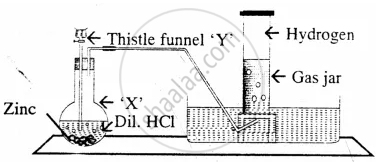
State, why hydrogen is collected after all the air in the apparatus, is allowed to escape.
