Advertisements
Advertisements
Question
In the laboratory preparation of hydrogen from zinc & dilute hydrocholoric acid – state a reason for the addition of traces of copper [II] sulphate to the reaction medium.
Advertisements
Solution
Addition of traces of copper [II] sulphate acts as catalyst and speeds up the reaction.
APPEARS IN
RELATED QUESTIONS
Indicate which of the following statement is true and which is false:
Nitric acid cannot be used to prepare hydrogen by its action on active metals.
Indicate which of the following statement is true and which is false:
Zinc can liberate hydrogen from water, acid and alkali solution.
Name the following:
A metallic oxide which can be reduced into metal by hydrogen.
Multiple Choice Question
In metal activity series the more reactive metals are at
FILL IN THE BLANK
Sodium liberates hydrogen when treated with cold .............
TRUE \ FALSE
Lead reacts briskly with dilute hydrochloric acid to form hydrogen.
Name the impurities present in hydrogen prepared in the laboratory.
Give reason:
Apparatus for laboratory preparation of hydrogen should be airtight and away from a naked flame.
How would you show that hydrogen is lighter than air?
Starting from zinc how would you obtain hydrogen using an alkali.
[Give balanced equation & name the product formed in the case other than hydrogen].
Name a metal which will not react with the reactants above to give hydrogen.
In the laboratory preparation of hydrogen from zinc & dilute hydrocholoric acid – state a reason for the collecting the hydrogen by downward displacement of water and not air & collecting it after all the air in the apparatus is allowed to escape.
Give balanced equation for the following conversion:
Acidified water to hydrogen – by electrolysis.
Give reason for the following:
Copper does not displace hydrogen from dilute hydrochloric acid, but zinc does.
Give a balanced equation for the following conversions sodium plumbite from lead.
In the laboratory preparation of hydrogen from zinc and dil. acid. Give a reason for the following:
The complete apparatus is air-tight.
In the laboratory preparation of hydrogen from zinc and dil. acid. Give a reason for the following:
The lower end of the thistle funnel should dip below the level of the acid in the flask.
The diagram represent the preparation and collection of hydrogen by a standard
laboratory method.
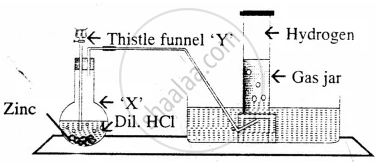
State what is added through the thistle funnel ‘Y’
The diagram represent the preparation and collection of hydrogen by a standard laboratory method.
Name a solution which absorbs the impurity – `"H"_2"S"`
The diagram represent the preparation and collection of hydrogen by a standard laboratory method.
State, why hydrogen is collected after all the air in the apparatus, is allowed to escape.
