Advertisements
Advertisements
Question
Monomers ethylene glycol and terephthalic acid undergo condensation polymerization to give polymer called ___________
Advertisements
Solution
Monomers ethylene glycol and terephthalic acid undergo condensation polymerization to give polymer called terylene (or Dacron)
APPEARS IN
RELATED QUESTIONS
Write the reactions involved in the preparation of PVC
Write the formulae of the raw materials used for preparation of Dextran.
Write the monomers of the following polymer :
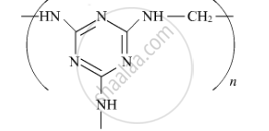
Choose the correct option from the given alternatives.
Which of the following is made up of polyamides?
Answer the following in one sentence.
Define the term: Vulcanization
Answer the following.
Write structure of natural rubber and neoprene rubber along with the name and structure of their monomers.
Draw the structures of polymers formed from the following monomers
\[\ce{n HOOC–R–COOH + n HO–R'–OH}\]
Name and draw structure of the repeating unit in natural rubber.
Identify condensation polymers and addition polymers from the following.

Answer the following.
Write main specialities of Buna-S, Neoprene rubber?
Monomer used for preparation of polyacrylonitrile is _____________
Write a chemical reaction for the preparation of the following polymer.
polyacrylonitrile
write the structure of the monomer used in natural rubber.
Mention two uses of LDP.
Write the name of one example of each polymer in which following repeating units.
\[\begin{array}{cc}
\ce{(-CF2-CF2-), -[NH-(CH2)5-CO] -, -(CH2-CH-), (-CH2-CH2-)}\\
\phantom{............................}|\\
\phantom{..............................}\ce{CN}
\end{array}\]
Write chemical reactions for the preparation of high-density polythene.
Write two uses and two properties of polythene.
Explain vulcanization of rubber.
Which of the following is used as a substitute for wool?
Which among the following polymers is used for making handles of cooker?
How many isoprene units are present in abscisic acid?
Which of the following polymers is a heteropolymer?
Which of the following catalysts is used in preparation of terylene?
Which of the following compounds is used to prepare orlon?
Which among the following catalysts is used in the preparation of dacron?
Identify the monomers used in the preparation of Novolac.
Which of the following monomers is used in the manufacture of Neoprene rubber?
Which of the following pair of compounds is used as monomers for bakelite?
Which of the following polymers is used as insulation for cables?
The commercial name of polyacrylonitrile is ______.
Which of the following products is formed when benzaldehyde is treated with CH3MgBr and the addition product so obtained is subjected to acid hydrolysis?
Which one of the following polymers are prepared by addition polymerization?
Which of the following polymers do not involve cross linkages?
Answer the following.
Name and draw structure of the repeating unit in natural rubber.
Answer the following.
Write the structure of isoprene and the polymer obtained from it.
Write the preparation of viscose rayon.
Write the structure of isoprene and the polymer obtained from it.
Another name of terylene is ______.
Match the following pairs:
| Polymer | Monomer | ||
| (i) | Teflon | (a) | CH2 = CH2 |
| (ii) | PVC | (b) | CF2 = CF2 |
| (iii) | Natural rubber | (c) | Isoprene |
| (iv) | Polythene | (d) | H2C=CHCl |
The monomer used in preparation of teflon is ______.
Write the structure and name of monomer of natural rubber.
Write the structure of isoprene and the polymer obtained from it.
Name and draw structure of the repeating unit in natural rubber.
Write the structure of isoprene and the polymer obtained from it.
Name and draw structure of the repeating unit in natural rubber.
Write the structure of isoprene and the polymer obtained from it.
Which among the following is a monomer of natural rubber?
