Advertisements
Advertisements
Question
Minimise Z = 13x – 15y subject to the constraints: x + y ≤ 7, 2x – 3y + 6 ≥ 0, x ≥ 0, y ≥ 0
Advertisements
Solution
Given that: Z = 13x – 15y and the constraints
x + y ≤ 7, 2x – 3y + 6 ≥ 0, x ≥ 0, y ≥ 0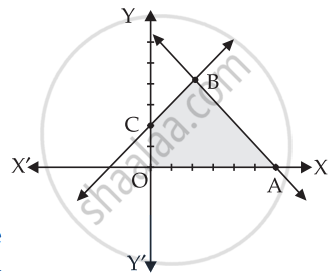
Let x + y = 7
| x | 3 | 4 |
| y | 4 | 3 |
Let 2x – 3y + 6 = 0
| x | 1 | -3 |
| y | 2 | 0 |
The shaded region is the feasible region determined by the constraints x + y ≤ 7, 2x – 3y + 6 ≥ 0, x ≥ 0, y ≥ 0
The feasible region is bounded with four corners O(0, 0), A(7, 0), B(3, 4), C(0, 2)
So, the maximum value can occur at any corner.
Let us evaluate the value of Z.
| Corner points | Value of Z | |
| O(0, 0) | 13(0) – 15(0) = 0 | |
| A(7, 0) | 13(7) – 15(0) = 91 | |
| B(3, 4) | 13(3) – 15(4) = – 21 | |
| C(0, 2) | 13(0) – 15(2) = – 30 | ← Minimum |
Hence, the minimum value of Z is – 30 at (0, 2).
APPEARS IN
RELATED QUESTIONS
Solve the following Linear Programming Problems graphically:
Minimise Z = – 3x + 4 y
subject to x + 2y ≤ 8, 3x + 2y ≤ 12, x ≥ 0, y ≥ 0.
Solve the following Linear Programming Problems graphically:
Maximise Z = 5x + 3y
subject to 3x + 5y ≤ 15, 5x + 2y ≤ 10, x ≥ 0, y ≥ 0
Solve the following Linear Programming Problems graphically:
Minimise Z = 3x + 5y
such that x + 3y ≥ 3, x + y ≥ 2, x, y ≥ 0.
Solve the following Linear Programming Problems graphically:
Maximise Z = 3x + 2y
subject to x + 2y ≤ 10, 3x + y ≤ 15, x, y ≥ 0.
Solve the following Linear Programming Problems graphically:
Minimise Z = x + 2y
subject to 2x + y ≥ 3, x + 2y ≥ 6, x, y ≥ 0.
If the feasible region for a linear programming problem is bounded, then the objective function Z = ax + by has both a maximum and a minimum value on R.
The minimum value of the objective function Z = ax + by in a linear programming problem always occurs at only one corner point of the feasible region
Maximise Z = 3x + 4y, subject to the constraints: x + y ≤ 1, x ≥ 0, y ≥ 0
Determine the maximum value of Z = 3x + 4y if the feasible region (shaded) for a LPP is shown in Figure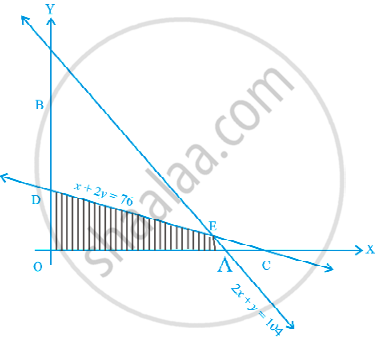
In figure, the feasible region (shaded) for a LPP is shown. Determine the maximum and minimum value of Z = x + 2y.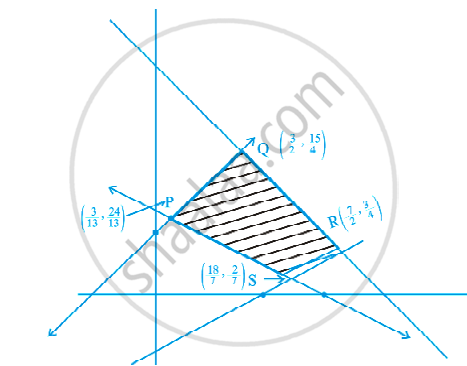
A man rides his motorcycle at the speed of 50 km/hour. He has to spend Rs 2 per km on petrol. If he rides it at a faster speed of 80 km/hour, the petrol cost increases to Rs 3 per km. He has atmost Rs 120 to spend on petrol and one hour’s time. He wishes to find the maximum distance that he can travel. Express this problem as a linear programming problem
Refer to question 13. Solve the linear programming problem and determine the maximum profit to the manufacturer
Refer to question 14. How many sweaters of each type should the company make in a day to get a maximum profit? What is the maximum profit.
Maximise Z = x + y subject to x + 4y ≤ 8, 2x + 3y ≤ 12, 3x + y ≤ 9, x ≥ 0, y ≥ 0.
Refer to Question 30. Minimum value of F is ______.
In a LPP, the linear inequalities or restrictions on the variables are called ____________.
A corner point of a feasible region is a point in the region which is the ______ of two boundary lines.
The feasible region for an LPP is always a ______ polygon.
If the feasible region for a LPP is unbounded, maximum or minimum of the objective function Z = ax + by may or may not exist.
In the given graph, the feasible region for an LPP is shaded. The objective function Z = 2x – 3y will be minimum at:

In a LPP, the objective function is always ____________.
Maximize Z = 4x + 6y, subject to 3x + 2y ≤ 12, x + y ≥ 4, x, y ≥ 0.
The feasible region for an LPP is shown shaded in the figure. Let Z = 3x - 4y be the objective function. Minimum of Z occurs at ____________.

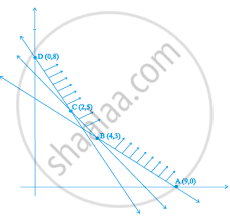
The feasible region for an LPP is shown shaded in the following figure. Minimum of Z = 4x + 3y occurs at the point.
Which statement best describes a Linear Programming Problem (LPP)?
Which expression has the general form of an objective function with constants \(a\) and \(b\)?
Which statement defines an Optimisation Problem?
Linear Programming is a method of optimisation under which type of constraints?
What are restrictions on decision variables called in linear programming?
Which component must always be included in a Linear Programming Problem?
