Advertisements
Advertisements
Question
Match the complex ions given in Column I with the colours given in Column II and assign the correct code:
| Column I (Complex ion) | Column II (Colour) |
| A. \[\ce{[Co(NH3)6]^{3+}}\] | 1. Violet |
| B. \[\ce{[Ti(H2O)6]^{3+}}\] | 2. Green |
| C. \[\ce{[Ni(H2O)6]^{2+}}\] | 3. Pale blue |
| D. \[\ce{(Ni(H2O)4 (en)]^{2+} (aq)}\] | 4. Yellowish orange |
| 5. Blue |
Options
A - (1), B - (2), C - (4), D - (5)
A - (4), B - (3), C - (2), D - (1)
A - (3), B - (2), C - (4), D - (1)
A - (4), B - (1), C - (2), D - (3)
Advertisements
Solution
A - (4), B - (3), C - (2), D - (1)
Explanation:
| Column I (Complex ion) | Column II (Colour) |
| A. \[\ce{[Co(NH3)6]^{3+}}\] | 4. Yellowish orange |
| B. \[\ce{[Ti(H2O)6]^{3+}}\] | 3. Pale blue |
| C. \[\ce{[Ni(H2O)6]^{2+}}\] | 2. Green |
| D. \[\ce{(Ni(H2O)4 (en)]^{2+} (aq)}\] | 1. Violet |
APPEARS IN
RELATED QUESTIONS
What is the coordination entity formed when excess of aqueous KCN is added to an aqueous solution of copper sulphate? Why is it that no precipitate of copper sulphide is obtained when H2S(g) is passed through this solution?
Predict the co-ordination No. of cs+ ion if `r_(Cs)^+` = 1.69Å and `r_(Cl)^-` = 1.81Å.
IUPAC name of the following compound is
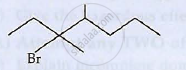
(a) 3 - Bromo- 3, 4- dimethylheptane
(b) 3, 4- dimethyl - 3- bromoheptane
(c) 5- Bromo- 4, 5- dimethylheptane
(d) 4, 5- dimethyl- 5- bromoheptane
How is Benzonitrile converted to Benzophenone?
Write structures of compounds A, B and C in of the following reactions

Write IUPAC name of the following Complex [Cr(NH3)3Cl3]
Write the IUPAC name of the following coordination compound:
[Cr(NH3)4(H2O)2]Cl3
Write structures of compounds A and B of the following reaction :

The correct \[\ce{IUPAC}\] name of \[\ce{[Pt(NH3)2Cl2]}\] is ______.
A complex of the type \[\ce{[M(AA)2X2]^{n+}}\] is known to be optically active. What does this indicate about the structure of the complex? Give one example of such complex.
What are Homoleptic complexes?
Given below are two statements.
Statement I: In CuSO4·5H2O, Cu-O bonds are present.
Statement II: In CuSO4·5H2O, ligands coordinating with Cu(II) ion are O- and S-based ligands.
In light of the above statement, choose the correct answer from the options given below.
The equivalents of ethylene diamine required to replace the neutral ligands from the coordination sphere of the trans-complex of CoCl3.4NH3 is ______. (Round off to the Nearest Integer).
The correct order of the spin-only magnetic moment of metal ions in the following low spin complexes,
\[\ce{[V(CN)6]^{4-}, [Fe(CN)6]^{4-}, [Ru(NH3)6]^{3+} and [Cr(NH3)6]^2}\] is:
The one that will show optical activity is: (en = ethane 1, 2-diamine)
Which of the following species cannot act as a ligand? Give reason.
What is meant by the chelate effect? Give an example.
Explain the following, giving two examples:
Coordination polyhedron
Explain the following, giving two examples:
Homoleptic
