Advertisements
Advertisements
Question
Match the meanings with the words/expressions in italic, and write the appropriate
meaning next to the sentence.
He nearly jumped out of his skin when he saw the bull coming towards him.
Advertisements
Solution
He nearly jumped out of his skin when he saw the bull coming towards him. (very
frightened)
RELATED QUESTIONS
Answer of these question in a short paragraph (about 30 words).
Why was Margie doing badly in geography? What did the County Inspector do to help
her?
An e-mail, short for electronic mail is a store and forward method of composing, sending, storing, and receiving messages over electronic communication systems. It is the quickest way to communicate in writing.
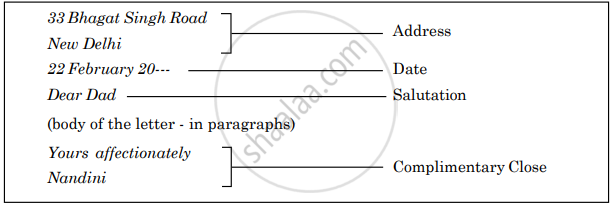
When we write informal letters (to a friend, or to a member of our family), we use this layout.
The black man's face bespoke revenge
As the fire passed from his sight.
For all he saw in his stick of wood
Was a chance to spite the white.
The last man of this forlorn group
Did nought except for gain.
Giving only to those who gave
Was how he played the game.
Their logs held tight in death's still hands
Was proof of human sin.
They didn't die from the cold without
They died from the cold within.
Read the lines given above and answer the question that follow.
Who are ‘they’ referred to here ? Where were they ?
The women came out on the shore, and made for the stepping—?stones. They had plenty to laugh and bicker about, as they approached the river in a noisy crowd. They girded up their skirts, so as to jump from stone to stone, and they clanked their sickles and forks together over their shoulders to have ease of movement. They shouted their quarrels above the gush of the river. Noise frightens crocodiles. The big mugger did not move, and all the women crossed in safety to the other bank. Here they had to climb a steep hillside to get at the grass, but all fell to with a will, and sliced away at it wherever there was foothold to be had. Down below them ran the broad river, pouring powerfully out from its deep narrow pools among the cold cliffs and shadows, spreading into warm shallows, lit by kingfishers. Great turtles lived there, and mahseer weighing more than a hundred pounds. Crocodiles too. Sometimes you could see them lying out on those slabs of clay over there, but there were none to be seen at the moment.
Read the extract given below and answer the question that follow.
What did the women carry?
Discuss the following topic in groups.
When a group of bees finds nectar, it informs other bees of it's location, quantity, etc. through dancing. Can you guess what ants communicate to their fellow ants by touching one another’s feelers?
Answer the following question
Whom does Golu ask, “Why don’t you ever fly like other birds?”
Do you think the atmosphere of Mr Purcell’s shop was cheerful or depressing? Give reasons for your answer.
Discuss the following topic in groups.
Freedom is life. Discuss this with reference to ‘Chandni’ and ‘I Want Something in a Cage’.
Answer the following question
Would you like to be a rebel? If yes, why? If not, why not?
What do you know about the Viking Mission to Mars?
What did the monkey do as he reached the tree?
What have certain doctors found about dreams?
In what way is Pambupatti different from any other village?
Describe the tone in which the narrator’s father dismissed his wife’s warnings every single time.
What surprises do the meadows have to offer you?
Multiple Choice Question:
When is beauty heard?
Do you think it is good to be a rebel?
Add im- or in- to each of the following words and use them in place of the italicised words in the sentences given below.
| patient, proper, possible, sensitive, competent |
The project appears very difficult at first sight but it can be completed if we work very hard.
Discuss the absence of human characters in the story, There Will Come Soft Rains. How does this absence contribute to the overall tone and message of the narrative? Answer in 200-250 words.
