Advertisements
Advertisements
Question
Why did Gopal’s wife find his activities strange?
Advertisements
Solution
Gopal had half-shaven his face. Smeared ash over himself. Had put on rags and was looking disgraceful. She asked Gopal the reason for such weird acts. She stopped him from going out like that but Gopal told her that he was going to buy Hilsa fish. At last she concluded that Gopal had gone mad.
RELATED QUESTIONS
Explain what the reason for the following is .
What do these tell you about Einstein?
Thinking about the Text
On the following map mark out the route, which the author thought of but did not take, to Delhi.

Pick out word from the text that mean the same as the following word or expression. (Look in the paragraph indicated.)
a strong desire arising from within : _________
The poem is about a brook. A dictionary would define a brook, as a stream or a
small river. Read the poem silently first. After the first reading, the teacher will
make you listen to a recording of the poem. What do you think the poem is all
about?
I come from haunts of coot and hern;
I make a sudden sally
And sparkle out among the fern,
To bicker down a valley.
By thirty hills I hurry down,
Or slip between the ridges,
By twenty thorpes, a little town,
And half a hundred bridges.
Till last by Philip's farm I flow
10 To join the brimming river,
For men may come and men may go,
But I go on for ever.
I chatter over stony ways,
In little sharps and trebles,
15 I bubble into eddying bays,
I babble on the pebbles.
With many a curve my banks I fret
By many a field and fallow,
And many a fairy foreland set
20 With willow-weed and mallow.
I chatter, chatter, as I flow
To join the brimming river,
For men may come and men may go,
But I go on for ever.
25 I wind about, and in and out,
With here a blossom sailing,
And here and there a lusty trout,
And here and there a grayling,
And here and there a foamy flake
30 Upon me, as I travel
With many a silvery waterbreak
Above the golden gravel,
And draw them all along, and flow
To join the brimming river
35 For men may come and men may go,
But I go on for ever.
I steal by lawns and grassy plots,
I slide by hazel covers
I move the sweet forget-me-nots
40 That grow for happy lovers.
I slip, I slide, I gloom, I glance,
Among my skimming swallows;
I make the netted sunbeam dance
Against my sandy shallows.
45 I murmur under moon and stars
In brambly wildernesses;
I linger by my shingly bars;
I loiter round my cresses;
And out again I curve and flow
50 To join the brimming river,
For men may come and men may go,
But I go on for ever.
About the Poet
Lord Tennyson (1809-92) was born in Lincolnshire. Poet Laureate for over 40 years, Tennyson is representative of the Victorian age. His skilled craftsmanship and noble ideals retained a large audience for poetry in an age when the novel was engrossing more and more readers. Tennyson's real contribution lies in his shorter poems like The Lady of Shallot, The Princess, Ulysses, The Palace of Art etc. His fame rests on his perfect control of sound, the synthesis of sound and meaning, and the union of visual and musical.
Read the comic strip based on. H.G. Wells' novells.


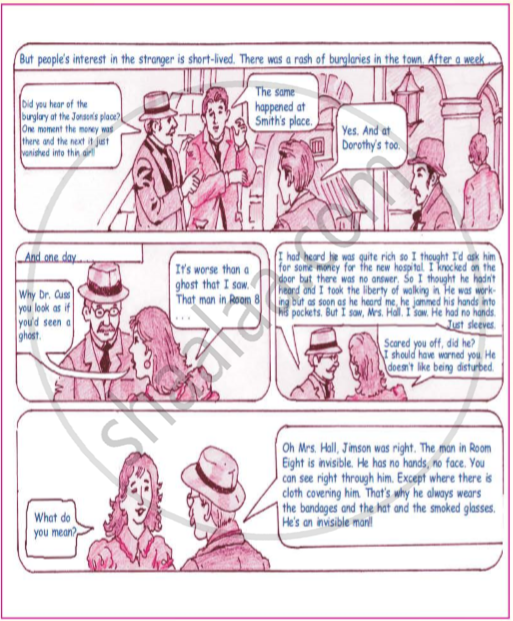
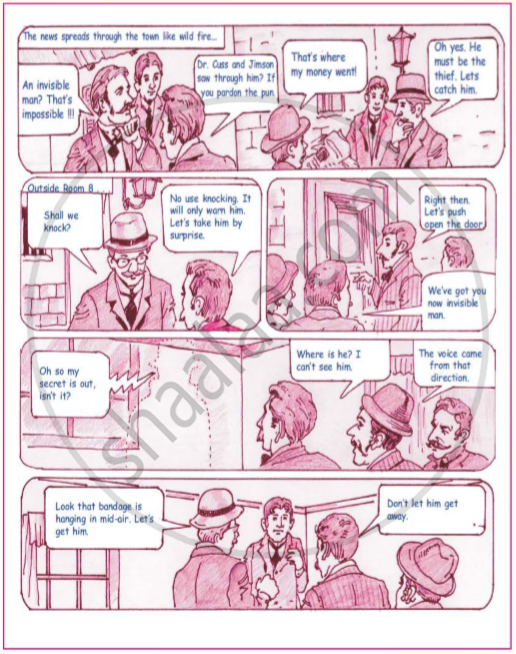
Answer the questions by ticking the correct option.
(a) The strange-looking man wanted ....
(i) the best room at the inn.
(ii} a room with a fire and a good lock.
(iii} a room with a good view.
(iv) a room where he could work quietly.
(b) Jimson was suspicious of the stranger because ...
(i} he did not answer Jimson's questions.
(ii} he did not want to talk about the weather.
(iii} he kept his back turned towards Jimson at all times.
(iv) he shouted atJimson when he entered his room.
(c) The people of the town gossiped about the stranger as ...
(i} he did not go out or talk to anyone in the town.
(ii} he had met with an accident and his face was bandaged.
(iii} he was new to the town and behaved rudely.
(iv) he stayed in his room and did not show his face to anyone.
(d) 'There was a rush of burglaries in the town. This means that ________
(i} there were many robberies in the town.
(ii) a few people in the town had seen a rob her.
(iii} the burglaries in the town were done in a rush.
(iv) the burglar was a rash and careless man.
(e) Although Jimson and Dr Cuss are suspicious of the strange guest, Mrs Hall tolerates him because ....
(i} she is not superstitious or ignorant.
(ii) she is sorry for the stranger who is bandaged.
(iii} the stranger is paying her a good amount of money for the room.
(iv} the stranger is polite and kind to Mrs Hall at all times.
(f) The stranger who was staying at the inn can be described as being ....
(I} violent
(ii} upright
(iii} dishonest
(iv) sensible
What does he plant who plants a tree? a
He plants a friend of sun and sky;b
He plants the flag of breezes free;
The shaft of beauty, towering high;
He plants a home to heaven anigh;
For song and mother-croon of bird
In hushed and happy twilight heard____
The treble of heaven's harmony_____
These things he plants who plants a tree.
Read the lines given above and answer the question that follow:
The blocks were all lined up for those who would use them
The hundred-yard dash and the race to be run
These were nine resolved athletes in back of the starting line
Poised for the sound of the gun.
The signal was given, the pistol exploded
And so did the runners all charging ahead
But the smallest among them,he stumbled and staggered
And fell to the asphalt instead.
He gave out a cry in frustration and anguish
His dreams ands his efforts all dashed in the dirt
But as sure I'm standing here telling this story
The same goes for what next occurred.
Read the lines given above and answer the following question:
How were the dreams of one of the contestants ‘dashed in the dirt’?
Answer the following question.
What are some of the signs of approaching winter referred to in the text?
The following sentence has two blanks. Fill in the blanks with appropriate forms of the word given in brackets.
Asking for_________ is as noble as willingness to________ . (forgive)
What were the remarks of two men on seeing Gopal in the market?
Who looks after the grubs and how?
Which line shows a complete change of the child’s attitude towards snakes? Read it aloud.
Use the clues given below to complete this crossword puzzle.
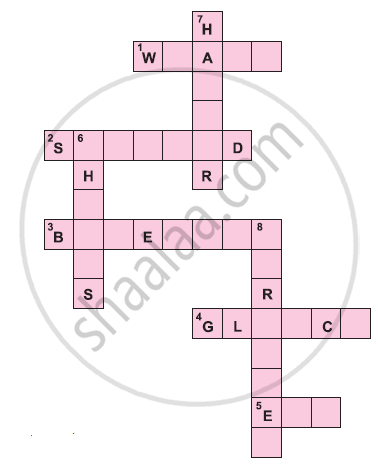
Across
1. very tired
2. had an angry look on the face
3. short trousers
4. a fault in a machine that prevents it from working properly
5. a small and naughty boy-fairy
Down
6. work that must be done every day, often boring
7. a basket with a lid
8. gave a short, high-pitched cry
Multiple Choice Question:
Brick, stone, wood, etc. are required to make a ________
What does he want to know about his teacher? Why?
Identify the ‘he’ in the first line.
Do you think Mr Gessler was a failure as a bootmaker or as a competitive businessman?
What does Nishad find out about Mr Nath from Ramesh?
Arrange the information as suggested below.
- What he eats
- When he eats
- What he drinks and when
- How he pays
The words helper, companion, partner and accomplice have very similar meanings, but each word is typically used in certain phrases. Can you fill in the blanks below with the most commonly used words? A dictionary may help you.
a faithful …………… such as dog.
Gratiano explains, "We are the Jasons, we have won the fleeee." In this context the word 'fleeee' refers to ______.
