Advertisements
Advertisements
Question
Massive poaching in the past two years has wiped out the entire tiger population at one of the tiger reserves in India,' claims an investigation report.
Study the information in 7 and 8 and notice how the number of tigers are falling. Using the information, write a paragraph in about 150 words on Project Tiger.
Advertisements
Solution
Tigers are very important animals for the ecosystem. But growing human population and growing human greed is endangering the existence of tigers on this planet. Especially in India the tiger population is reduced drastically. At present the estimated population of tiger in India is between 2500 – 3800, which is not a great figure. Many tiger parts are used by humans because of age old misconceptions. This has always led humans to kill tigers for precious body parts.
Apart from this, growing human activity in tiger’s habitat has resulted in creating pressure on tiger population. Deforestation is leading to the loss of habitat for tigers. This can play havoc with the ecosystem as tigers are at the top of the food chain. They help to check the population of many hervbivores under control. Drastic steps need to be taken to ensure survival of tigers. As responsible inhabitants of this planet, it is our duty to leave a prosperous planet for the fixture generations.
APPEARS IN
RELATED QUESTIONS
Listen to a speech by the honourable former President of India, Dr APJ Abdul Kalam, on his 'Vision for India'. While listening, fill up the following details.
a . The following countries captured our lands and conquered our minds.
-----------------------------------------------------------------------------------------------------------------------
b . His first vision had been that of ---------------
c . His second vision was -----------------------
d . The three scientists who worked with him at ISRO were -------------------------------------------
e . India leads in --------------------------- and is the second largest producer of ----------------------
Now that you have enjoyed reading the story, answer the following question by choosing the correct option
Why did the grandmother touch her granddaughter's feet?
With your partner, discuss and narrate an incident about a person who likes to show off.
Check whether your classmates agree with you.
Answer the following question briefly:
How was Private Quelch’s knowledge exposed even further as the Sergeant’s classes went on?
On the basis of your understanding of the poem, answer the following questions
by ticking the correct choice.
The poet draws a parallelism between the journey of the brook with ___________.
Answer the following questions:
Bicker’ means ‘to quarrel’. Why does the poet use this word here?
| Stages | Characteristics |
| infancy | crying |
Answer the following question.
"If you got a tooth, you got a friend", what do you understand from the line?
Discuss in groups
What would you do in the following situations? Give reasons for your answer
If you were travelling by bus and you saw someone pick another passenger's
pocket.
- If you found a wallet on the road.
- If you were in a shop and you saw a well-dressed lady shoplifting.
- If your best friend is getting involved with an undesirable set of friends.
- If you were in school and you saw one of your class-mates steal another child's
pen.
Select words from the above box to describe the characters in the play as
revealed by the following lines from the play.
| Lines from the play | Speaker | Quality revealed | |
| 1. | “You told him she was feeling poorly, did you ? And so my brother is to be kept out of bed, and go without his supper because you told him she was feeling poorly. ” | ||
| 2. | ….. “take my comforter, it will keep you warm. ” | ||
| 3. | “If people lie to me they are poorer, not I. ” | ||
| 4. | “You are like a child. I can’t trust you out of my sight. No sooner my back is turned than you get that minx Marie to sell the silver salt cellars. ” | ||
| 5. | “My dear there is so much suffering in the world, and I can do so very little. ” | ||
| 6. | “My mother gave them to me on—on her death bed just after you were born, and…. and she asked me to keep them in remembrance of her, so I would like to keep them. ” | ||
| 7. | “I am too old a bird to be caught with chaff. ” | ||
| 8. | “You have your soul to lose, my son.” | ||
| 9. | “Give me food or I’ll stick my knife in you both and help myself. ” | ||
| 10. | “…they have made me what I am, they have made me a thief. God curse them all. ” | ||
| 11. | “Why the devil are you kind to me? What do you want? ” | ||
| 12. | “I—I—didn’t believe there was any good in the world… but somehow I—I—know you’re good, and —and it’s a queer thing to ask, but could you, would you bless me before I go? ” |
Imagine that you are one of the boys, and that the map on the next page is of the island on which you have landed. Your most urgent task is to decide where to live. Work in groups of four; decide where to set up camp, and the materials you will use. Be prepared to justify your choices to the rest of the class.
Compounds—someone, nothing etc.
| someone | anyone | none | everyone |
| somebody | anybody | nobody | everybody |
| something | anything | nothing | everything |
| somewhere | anywhere | nowhere | everywhere |
(Words ending with one and body mean the same.)
Fill in the gaps with some of the words from the table above:
- He can’t hear _____ . He’s completely deaf.
- _______ is going blurred. I can’t see!
- He’s looked ______ but he can’t find it.
- It must be _________ ! Look carefully.
- ______ must move or the horse will be scared.
- It doesn’t matter what you wear, ______ will do.
- She is very popular. _______ likes her.
- Shh! There is _____________ moving downstairs.
- Don’t worry! It’s _________ frightening. It is only the wind.
- It’s a public holiday, so____________ is open.
The table below provides you with a list of modals that are used to express necessity and permission.
| Necessity I obligation | Permission |
|
Positive must obeying have to authority need to ought to right thing should to do |
Positive can (less formal) may (more formal)
|
|
Negative must not cannot ought not to |
Negative need not do not have to
|
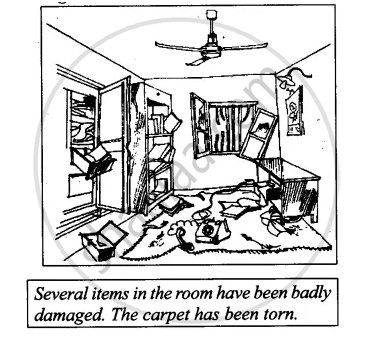
Present perfect passive
Inspector Narayan has been called to investigate a burglary. When he arrives, there is total chaos in the room. He makes notes about what has been damaged. You are Inspector Narayan. Look at the picture and complete the description, using the Present Perfect Passive.
Given alongside are the pictures of two boys - Shravan Kumar and Narendra Kumar. (They are not related.) Working with a partner, look at their pictures and predict how each boys lives. Write your answer in points .

| Shravan Kumar | Narendra Kumar |
Study the following graph and the accompanying report.

Our study of the time spent by students at the computer and studying at home in three countries has revealed some interesting facts.
First, the majority of boys and girls in the age groups of 14-16 in these countries spend more time at the computer than studying at home. Children in these countries spend an average of20-30 hours per week in comparison to 10-15 hours of studying at home. The only exception is Burland where girls spend more time studying at home than at the computer.
Secondly it is evident that in all three countries, time spent at the computer is having a serious impact on the number of hours spent studying at home. In fact, the greater the number of hours spent at the computer, the fewer number of hours are being spent studying. For example, boys in Burland spend an average of 32 hours at the computer while they spend about 8 hours studying at home.
This description is taken from a well-known film. Can you guess which one?
A man in a red cape and blue tights is flying over a city. On his chest is the letter S. Below him a large crowd is pointing up at him.
Imagine a scene from a play, film or TV show you have seen.
Describe (a) where things and people are, and (b) any movement. Follow the example.
Show your description to your partner. Guess each other’s play or film.____________________________________________________________________________________________________
20 years from now, one of your class-mates becomes a famous sport-star. You have been asked to write his/her biography. Collect the necessary biographical details. Use your imagination to create his / her achievements in the sport concerned, and write the biography. Remember to write it in chronological order of events, and use the simple past tense as far as possible.
Verbs and Prepositions
Fill in the gaps with suitable prepositions
- You’re right. I agree __________ you.
- The conclusions are based __________ extensive research.
- He arrived __________ Delhi airport at 2 am and then arrived the city at 4 am.
- He angrily shouted __________ the pupil.
- “Remember the party!” she shouted __________ her friend.
- A differs __________ B in a number of ways.
- He applied __________ the teaching job but was turned down.
- She replied __________ his last letter.
- They apologized __________ breaking the vase.
- Do you believe __________ ghosts?
Below is a description of Geothermal Energy. Complete the passage by filling in the gaps choosing the correct option from the given options. The first one has been done for you.
In volcanic areas, underground water (a) can often rise to a temperature of 200° C. Nowadays, wells (b) __________ drilled to extract the steam which is used to drive turbines. This is (c) __________ of the world’s fastest growing sources of energy. (d) __________ the water is heated by enormous reservoirs of cooling rock several kilometers across, geothermal steam is (e) __________ to be a renewable energy resource. Even in non- volcanic areas, underground water can (f) __________ heated by natural radioactivity. In this case, (g) __________, it is necessary to drill deeper before the water is as hot as 200° C. This method (h) __________ used for heating homes in certain areas for many years and is cheap, clean and efficient.
| (a) (i) could (ii) can (iii) must (iv) might |
(b) (i) is (ii) been (iii) are (iv) being |
(c) (i) any (ii) some (iii) one (iv) few |
(d) (i) As (ii) While (iii) Though (iv) Even |
| (e) (i) called (ii) said (iii) regarded (iv) told |
(f) (i) be (ii) been (iii) being (iv) is |
(g) (i) however (ii) though (iii) despite (iv) therefore |
(h) (i) being (ii) was (iii) be (iv) has been |
