Advertisements
Advertisements
Question
Magnetic lines of force are closed continuous curves.
Advertisements
Solution
True.
APPEARS IN
RELATED QUESTIONS
How are the magnetic field lines different from the electrostatic field lines?
Answer the following question.
Write the four important properties of the magnetic field lines due to a bar magnet.
Answer the following question in brief.
What happens if a bar magnet is cut into two pieces transverse to its length/along its length?
Answer the following question in detail.
Two bar magnets are placed on a horizontal surface. Draw magnetic lines around them. Mark the position of any neutral points (points where there is no resultant magnetic field) on your diagram.
A closely wound solenoid of 800 turns and area of cross-section 2.5 × 10⁻⁴ m2 carries a current of 3.0 A. Explain the sense in which the solenoid acts like a bar magnet. What is its associated magnetic moment?
A closely wound solenoid of 2000 turns and area of cross-section 1.6 × 10⁻⁴ m2, carrying a current of 4.0 A, is suspended through its centre allowing it to turn in a horizontal plane.
- What is the magnetic moment associated with the solenoid?
- What is the force and torque on the solenoid if a uniform horizontal magnetic field of 7.5 × 10⁻² T is set up at an angle of 30° with the axis of the solenoid?
A closely wound solenoid of 2000 turns and area of cross-section 1.6 × 10⁻⁴ m2 , carrying a current of 4.0 A, is suspended through its centre allowing it to turn in a horizontal plane.
What is the force and torque on the solenoid if a uniform horizontal magnetic field of 7.5 × 10⁻² T is set up at an angle of 30° with the axis of the solenoid?
If the bar magnet is turned around by 180°, where will the new null points be located?
Magnetic field at far axial point due to solenoid as well as bar magnet varies ______.
Magnetic moment for solenoid and corresponding bar magnet is ______.
Four point masses, each of value m, are placed at the comers of a square ABCD of side L, the moment of inertia of this system about an axis through A and parallel to BD is ______.
A proton has spin and magnetic moment just like an electron. Why then its effect is neglected in magnetism of materials?
Verify the Ampere’s law for magnetic field of a point dipole of dipole moment m = m`hatk`. Take C as the closed curve running clockwise along (i) the z-axis from z = a > 0 to z = R; (ii) along the quarter circle of radius R and centre at the origin, in the first quadrant of x-z plane; (iii) along the x-axis from x = R to x = a, and (iv) along the quarter circle of radius a and centre at the origin in the first quadrant of x-z plane.
In a uniform magnetic field of 0.049 T, a magnetic needle performs 20 complete oscillations in 5 seconds as shown. The moment of inertia of the needle is 9.8 × 10⁻⁶ kg m2. If the magnitude of magnetic moment of the needle is x × 10−5 Am2; then the value of ‘x’ is:
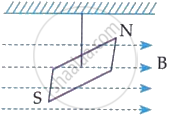
In a uniform magnetic field of 0.049 T, a magnetic needle performs 20 complete oscillations in 5 seconds as shown. The moment of inertia of the needle is 9.8 × 10⁻⁶ kg m2. If the magnitude of magnetic moment of the needle is x × 10−5 Am2; then the value of ‘x’ is:
