English

A long straight wire of circular cross section of radius 'a' carries a steady current I. The current is uniformly distributed across its cross section. - Physics

Advertisements
Advertisements

Question

A long straight wire of circular cross section of radius 'a' carries a steady current I. The current is uniformly distributed across its cross section. The ratio of magnitudes of the magnetic field at a point `a/2` above the surface of wire to that of a point `a/2` below its surface is ______.

Options

  • 4 : 1

  • 1 : 1

  • 4 : 3

  • 3 : 4

MCQ
Fill in the Blanks
Advertisements

Solution

A long straight wire of circular cross section of radius 'a' carries a steady current I. The current is uniformly distributed across its cross section. The ratio of magnitudes of the magnetic field at a point `a/2` above the surface of wire to that of a point `a/2` below its surface is 4 : 3.

Explanation:
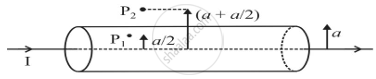
At P2, B2 = `(mu_0I)/(2pi((3a)/2)) = (mu_0I)/(3pia)`

At P1, B1 = `(mu_0(I//4))/(2pi(a//2)) = (mu_0I)/(4pia)`

`therefore B_2/B_1 = (((mu_0I)/(3pia)))/(((mu_0I)/(4pia))) => B_2/B_1 = 4/3`

shaalaa.com
  Is there an error in this question or solution?
2022-2023 (March) Sample

RELATED QUESTIONS

How are the magnetic field lines different from the electrostatic field lines?


A short bar magnet placed with its axis at 30° with a uniform external magnetic field of 0.25 T experiences a torque of magnitude equal to 4.5 × 10⁻² J. What is the magnitude of magnetic moment of the magnet?


When iron filings are sprinkled on a sheet of glass placed over a short bar magnet then, the iron filings form a pattern suggesting that the magnet has ______.


The magnetic lines of force inside a bar magnet ______.

The ratio of magnetic fields due to a smaller bar magnet in the end on position to broad side on position is ______.

The lines of force due to earth’s horizontal magnetic field are ______.

Four point masses, each of value m, are placed at the comers of a square ABCD of side L, the moment of inertia of this system about an axis through A and parallel to BD is ______.


Suppose we want to verify the analogy between electrostatic and magnetostatic by an explicit experiment. Consider the motion of (i) electric dipole p in an electrostatic field E and (ii) magnetic dipole m in a magnetic field B. Write down a set of conditions on E, B, p, m so that the two motions are verified to be identical. (Assume identical initial conditions.)


A bar magnet of magnetic moment m and moment of inertia I (about centre, perpendicular to length) is cut into two equal pieces, perpendicular to length. Let T be the period of oscillations of the original magnet about an axis through the midpoint, perpendicular to length, in a magnetic field B. What would be the similar period T′ for each piece?


Use (i) the Ampere’s law for H and (ii) continuity of lines of B, to conclude that inside a bar magnet, (a) lines of H run from the N pole to S pole, while (b) lines of B must run from the S pole to N pole.


Share
Notifications

Englishहिंदीमराठी


      Forgot password?
Use app×