Advertisements
Advertisements
प्रश्न
A long straight wire of circular cross section of radius 'a' carries a steady current I. The current is uniformly distributed across its cross section. The ratio of magnitudes of the magnetic field at a point `a/2` above the surface of wire to that of a point `a/2` below its surface is ______.
पर्याय
4 : 1
1 : 1
4 : 3
3 : 4
Advertisements
उत्तर
A long straight wire of circular cross section of radius 'a' carries a steady current I. The current is uniformly distributed across its cross section. The ratio of magnitudes of the magnetic field at a point `a/2` above the surface of wire to that of a point `a/2` below its surface is 4 : 3.
Explanation:
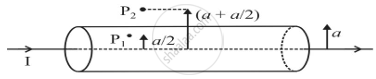
At P2, B2 = `(mu_0I)/(2pi((3a)/2)) = (mu_0I)/(3pia)`
At P1, B1 = `(mu_0(I//4))/(2pi(a//2)) = (mu_0I)/(4pia)`
`therefore B_2/B_1 = (((mu_0I)/(3pia)))/(((mu_0I)/(4pia))) => B_2/B_1 = 4/3`
संबंधित प्रश्न
A closely wound solenoid of 800 turns and area of cross-section 2.5 × 10⁻⁴ m2 carries a current of 3.0 A. Explain the sense in which the solenoid acts like a bar magnet. What is its associated magnetic moment?
A closely wound solenoid of 2000 turns and area of cross-section 1.6 × 10⁻⁴ m2 , carrying a current of 4.0 A, is suspended through its centre allowing it to turn in a horizontal plane.
What is the force and torque on the solenoid if a uniform horizontal magnetic field of 7.5 × 10⁻² T is set up at an angle of 30° with the axis of the solenoid?
Which of the following statements about bar magnet is correct?
Magnetic field at far axial point due to solenoid as well as bar magnet varies ______.
Magnetic moment for solenoid and corresponding bar magnet is ______.
When a current is passed through a tangent galvanometer, it gives a deflection of 30° for 60° correction, the current must be
Suppose we want to verify the analogy between electrostatic and magnetostatic by an explicit experiment. Consider the motion of (i) electric dipole p in an electrostatic field E and (ii) magnetic dipole m in a magnetic field B. Write down a set of conditions on E, B, p, m so that the two motions are verified to be identical. (Assume identical initial conditions.)
Use (i) the Ampere’s law for H and (ii) continuity of lines of B, to conclude that inside a bar magnet, (a) lines of H run from the N pole to S pole, while (b) lines of B must run from the S pole to N pole.
There are two current carrying planar coils made each from identical wires of length L. C1 is circular (radius R) and C2 is square (side a). They are so constructed that they have same frequency of oscillation when they are placed in the same uniform B and carry the same current. Find a in terms of R.
