Advertisements
Advertisements
Question
Choose the correct option.
Inside a bar magnet, the magnetic field lines
Options
are not present
are parallel to the cross-sectional area of the magnet
are in the direction from N pole to S pole
are in the direction from S pole to N pole
Advertisements
Solution
Inside a bar magnet, the magnetic field lines are in the direction from S pole to N pole.
APPEARS IN
RELATED QUESTIONS
How are the magnetic field lines different from the electrostatic field lines?
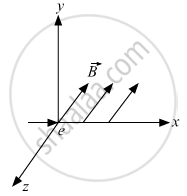
An electron moves along +x direction. It enters into a region of uniform magnetic field `vec B` directed along −z direction as shown in fig. Draw the shape of the trajectory followed by the electron after entering the field.
Solve the following problem.
A magnetic pole of a bar magnet with a pole strength of 100 A m is 20 cm away from the centre of a bar magnet. The bar magnet has a pole strength of 200 A m and has a length of 5 cm. If the magnetic pole is on the axis of the bar magnet, find the force on the magnetic pole.
Answer the following question in detail.
A circular magnet is made with its north pole at the centre, separated from the surrounding circular south pole by an air gap. Draw the magnetic field lines in the gap.
When iron filings are sprinkled on a sheet of glass placed over a short bar magnet then, the iron filings form a pattern suggesting that the magnet has ______.
Which of the following statement about magnetic field lines is true?
In which case of comparing solenoid and bar magnet there is no exact similarity?
Magnetic field at far axial point due to solenoid as well as bar magnet varies ______.
Magnetic moment for solenoid and corresponding bar magnet is ______.
Four point masses, each of value m, are placed at the comers of a square ABCD of side L, the moment of inertia of this system about an axis through A and parallel to BD is ______.
The magnetic moment of atomic neon is equal to
When a current is passed through a tangent galvanometer, it gives a deflection of 30° for 60° correction, the current must be
A magnetic needle suspended freely orients itself:-
A bar magnet of magnetic moment 3.0 Am is placed in a uniform magnetic field of 2 × 10⁻⁵T. If each pole of the magnet experience a force of 6 × 10⁻⁴ N, the length of the magnet is ______.
Magnetic dipole moment is a ______
A toroid of n turns, mean radius R and cross-sectional radius a carries current I. It is placed on a horizontal table taken as x-y plane. Its magnetic moment m ______.
A ball of superconducting material is dipped in liquid nitrogen and placed near a bar magnet. (i) In which direction will it move? (ii) What will be the direction of it’s magnetic moment?
There are two current carrying planar coils made each from identical wires of length L. C1 is circular (radius R) and C2 is square (side a). They are so constructed that they have same frequency of oscillation when they are placed in the same uniform B and carry the same current. Find a in terms of R.
A long straight wire of circular cross section of radius 'a' carries a steady current I. The current is uniformly distributed across its cross section. The ratio of magnitudes of the magnetic field at a point `a/2` above the surface of wire to that of a point `a/2` below its surface is ______.
A bar magnet is demagnetized by inserting it inside a solenoid of length 0.2 m, 100 turns, and carrying a current of 5.2 A. The coercivity of the bar magnet is ______.
