English
Karnataka Board PUCPUC Science 2nd PUC Class 12

A ball of superconducting material is dipped in liquid nitrogen and placed near a bar magnet. (i) In which direction will it move? (ii) What will be the direction of it’s magnetic moment? - Physics

Advertisements
Advertisements

Question

A ball of superconducting material is dipped in liquid nitrogen and placed near a bar magnet. (i) In which direction will it move? (ii) What will be the direction of it’s magnetic moment?

Short/Brief Note
Advertisements

Solution

A superconducting material and nitrogen both are diamagnetic in nature. When diamagnetic material is dipped in liquid nitrogen, it again behaves as a diamagnetic material. Thus, superconducting material will again behave as a diamagnetic material. When this diamagnetic material is placed near a bar magnet, it will be feebly magnetised opposite to the direction of magnetising field.
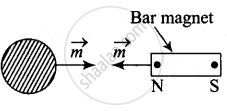
  1. So it will move away from the magnet.
  2. Magnetic moment is from left to right and it is opposite to the direction of magnetic field.
shaalaa.com
  Is there an error in this question or solution?
Chapter 5: Magnetism And Matter - MCQ I [Page 31]

APPEARS IN

NCERT Exemplar Physics [English] Class 12
Chapter 5 Magnetism And Matter
MCQ I | Q 5.15 | Page 31

RELATED QUESTIONS

A bar magnet of length 1 cm and cross-sectional area 1.0 cm2 produces a magnetic field of 1.5 × 10⁻⁴ T at a point in end-on position at a distance 15 cm away from the centre. (a) Find the magnetic moment M of the magnet. (b) Find the magnetisation I of the magnet. (c) Find the magnetic field B at the centre of the magnet.


Answer the following question.
Write the four important properties of the magnetic field lines due to a bar magnet.


Solve the following problem.

Two small and similar bar magnets have a magnetic dipole moment of 1.0 Am2 each. They are kept in a plane in such a way that their axes are perpendicular to each other. A line drawn through the axis of one magnet passes through the center of other magnet. If the distance between their centers is 2 m, find the magnitude of the magnetic field at the midpoint of the line joining their centers.


Answer the following question in detail.

Two bar magnets are placed on a horizontal surface. Draw magnetic lines around them. Mark the position of any neutral points (points where there is no resultant magnetic field) on your diagram.


A short bar magnet placed with its axis at 30° with a uniform external magnetic field of 0.25 T experiences a torque of magnitude equal to 4.5 × 10⁻² J. What is the magnitude of magnetic moment of the magnet?


In which case of comparing solenoid and bar magnet there is no exact similarity?


Magnetic field at far axial point due to solenoid as well as bar magnet varies ______.


Magnetic lines of force due to a bar magnet do not intersect because ______.

The magnetic lines of force inside a bar magnet ______.

Four point masses, each of value m, are placed at the comers of a square ABCD of side L, the moment of inertia of this system about an axis through A and parallel to BD is ______.


The resistance of ideal voltmeter is


When a current is passed through a tangent galvanometer, it gives a deflection of 30° for 60° correction, the current must be


When current is double deflection is also doubled in


A bar magnet of magnetic moment 3.0 Am is placed in a uniform magnetic field of 2 × 10⁻⁵T. If each pole of the magnet experience a force of 6 × 10⁻⁴ N, the length of the magnet is ______.


Magnetic dipole moment is a ______


A toroid of n turns, mean radius R and cross-sectional radius a carries current I. It is placed on a horizontal table taken as x-y plane. Its magnetic moment m ______.


A proton has spin and magnetic moment just like an electron. Why then its effect is neglected in magnetism of materials?


Suppose we want to verify the analogy between electrostatic and magnetostatic by an explicit experiment. Consider the motion of (i) electric dipole p in an electrostatic field E and (ii) magnetic dipole m in a magnetic field B. Write down a set of conditions on E, B, p, m so that the two motions are verified to be identical. (Assume identical initial conditions.)


Share
Notifications

Englishहिंदीमराठी


      Forgot password?
Use app×