Advertisements
Advertisements
प्रश्न
A ball of superconducting material is dipped in liquid nitrogen and placed near a bar magnet. (i) In which direction will it move? (ii) What will be the direction of it’s magnetic moment?
Advertisements
उत्तर
A superconducting material and nitrogen both are diamagnetic in nature. When diamagnetic material is dipped in liquid nitrogen, it again behaves as a diamagnetic material. Thus, superconducting material will again behave as a diamagnetic material. When this diamagnetic material is placed near a bar magnet, it will be feebly magnetised opposite to the direction of magnetising field.
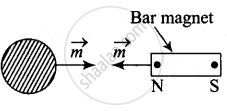
- So it will move away from the magnet.
- Magnetic moment is from left to right and it is opposite to the direction of magnetic field.
APPEARS IN
संबंधित प्रश्न
Predict the polarity of the capacitor in the situation described below :

Two bar magnets are placed close to each other with their opposite poles facing each other. In absence of other forces, the magnets are pulled towards each other and their kinetic energy increases. Does it contradict our earlier knowledge that magnetic forces cannot do any work and hence cannot increase kinetic energy of a system?
A bar magnet of length 1 cm and cross-sectional area 1.0 cm2 produces a magnetic field of 1.5 × 10⁻⁴ T at a point in end-on position at a distance 15 cm away from the centre. (a) Find the magnetic moment M of the magnet. (b) Find the magnetisation I of the magnet. (c) Find the magnetic field B at the centre of the magnet.
Choose the correct option.
Inside a bar magnet, the magnetic field lines
Answer the following question in detail.
Two bar magnets are placed on a horizontal surface. Draw magnetic lines around them. Mark the position of any neutral points (points where there is no resultant magnetic field) on your diagram.
A closely wound solenoid of 2000 turns and area of cross-section 1.6 × 10⁻⁴ m2 , carrying a current of 4.0 A, is suspended through its centre allowing it to turn in a horizontal plane.
What is the force and torque on the solenoid if a uniform horizontal magnetic field of 7.5 × 10⁻² T is set up at an angle of 30° with the axis of the solenoid?
If the bar magnet is turned around by 180°, where will the new null points be located?
Which of the following statement about magnetic field lines is true?
According to the dipole analogy 1/ε0 corresponds to ______.
Magnetic moment for solenoid and corresponding bar magnet is ______.
The magnetic moment of atomic neon is equal to
A magnetic needle suspended freely orients itself:-
A particle having charge 100 times that of an electron is revolving in a circular path by radius 0.8 with one rotation per second. The magnetic field produced at the centre is
A toroid of n turns, mean radius R and cross-sectional radius a carries current I. It is placed on a horizontal table taken as x-y plane. Its magnetic moment m ______.
Suppose we want to verify the analogy between electrostatic and magnetostatic by an explicit experiment. Consider the motion of (i) electric dipole p in an electrostatic field E and (ii) magnetic dipole m in a magnetic field B. Write down a set of conditions on E, B, p, m so that the two motions are verified to be identical. (Assume identical initial conditions.)
Use (i) the Ampere’s law for H and (ii) continuity of lines of B, to conclude that inside a bar magnet, (a) lines of H run from the N pole to S pole, while (b) lines of B must run from the S pole to N pole.
There are two current carrying planar coils made each from identical wires of length L. C1 is circular (radius R) and C2 is square (side a). They are so constructed that they have same frequency of oscillation when they are placed in the same uniform B and carry the same current. Find a in terms of R.
A long straight wire of circular cross section of radius 'a' carries a steady current I. The current is uniformly distributed across its cross section. The ratio of magnitudes of the magnetic field at a point `a/2` above the surface of wire to that of a point `a/2` below its surface is ______.
