Advertisements
Advertisements
प्रश्न
Choose the correct option.
Inside a bar magnet, the magnetic field lines
पर्याय
are not present
are parallel to the cross-sectional area of the magnet
are in the direction from N pole to S pole
are in the direction from S pole to N pole
Advertisements
उत्तर
Inside a bar magnet, the magnetic field lines are in the direction from S pole to N pole.
APPEARS IN
संबंधित प्रश्न
Magnetic lines of force are closed continuous curves.
Write any three properties of magnetic lines of force.
How are the magnetic field lines different from the electrostatic field lines?
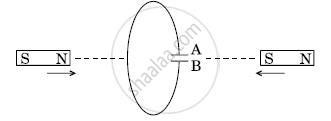
Predict the polarity of the capacitor in the situation described below :
An iron needle is attracted to the ends of a bar magnet but not to the middle region of the magnet. Is the material making up the ends of a bare magnet different from that of the middle region?
Two bar magnets are placed close to each other with their opposite poles facing each other. In absence of other forces, the magnets are pulled towards each other and their kinetic energy increases. Does it contradict our earlier knowledge that magnetic forces cannot do any work and hence cannot increase kinetic energy of a system?
Answer the following question.
Write the four important properties of the magnetic field lines due to a bar magnet.
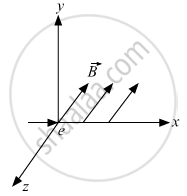
An electron moves along +x direction. It enters into a region of uniform magnetic field `vec B` directed along −z direction as shown in fig. Draw the shape of the trajectory followed by the electron after entering the field.
Answer the following question in brief.
What happens if a bar magnet is cut into two pieces transverse to its length/along its length?
Solve the following problem.
A magnetic pole of a bar magnet with a pole strength of 100 A m is 20 cm away from the centre of a bar magnet. The bar magnet has a pole strength of 200 A m and has a length of 5 cm. If the magnetic pole is on the axis of the bar magnet, find the force on the magnetic pole.
Answer the following question in detail.
A circular magnet is made with its north pole at the centre, separated from the surrounding circular south pole by an air gap. Draw the magnetic field lines in the gap.
A closely wound solenoid of 2000 turns and area of cross-section 1.6 × 10⁻⁴ m2, carrying a current of 4.0 A, is suspended through its centre allowing it to turn in a horizontal plane.
- What is the magnetic moment associated with the solenoid?
- What is the force and torque on the solenoid if a uniform horizontal magnetic field of 7.5 × 10⁻² T is set up at an angle of 30° with the axis of the solenoid?
When iron filings are sprinkled on a sheet of glass placed over a short bar magnet then, the iron filings form a pattern suggesting that the magnet has ______.
Magnetic field at far axial point due to solenoid as well as bar magnet varies ______.
Four point masses, each of value m, are placed at the comers of a square ABCD of side L, the moment of inertia of this system about an axis through A and parallel to BD is ______.
A bar magnet of magnetic moment 3.0 Am is placed in a uniform magnetic field of 2 × 10⁻⁵T. If each pole of the magnet experience a force of 6 × 10⁻⁴ N, the length of the magnet is ______.
Magnetic dipole moment is a ______
A proton has spin and magnetic moment just like an electron. Why then its effect is neglected in magnetism of materials?
A ball of superconducting material is dipped in liquid nitrogen and placed near a bar magnet. (i) In which direction will it move? (ii) What will be the direction of it’s magnetic moment?
Suppose we want to verify the analogy between electrostatic and magnetostatic by an explicit experiment. Consider the motion of (i) electric dipole p in an electrostatic field E and (ii) magnetic dipole m in a magnetic field B. Write down a set of conditions on E, B, p, m so that the two motions are verified to be identical. (Assume identical initial conditions.)
A long straight wire of circular cross section of radius 'a' carries a steady current I. The current is uniformly distributed across its cross section. The ratio of magnitudes of the magnetic field at a point `a/2` above the surface of wire to that of a point `a/2` below its surface is ______.
A bar magnet is demagnetized by inserting it inside a solenoid of length 0.2 m, 100 turns, and carrying a current of 5.2 A. The coercivity of the bar magnet is ______.
In a uniform magnetic field of 0.049 T, a magnetic needle performs 20 complete oscillations in 5 seconds as shown. The moment of inertia of the needle is 9.8 × 10⁻⁶ kg m2. If the magnitude of magnetic moment of the needle is x × 10−5 Am2; then the value of ‘x’ is: