Advertisements
Advertisements
Question
Locate instances of irony in the story.
Advertisements
Solution
The story The Luncheon is replete with instances of irony. The irony is a technique in which an unexpected situation is revealed either in terms of speech or incident. In other words, an ironical situation is never expected or anticipated. It happens and comes as a shock or surprise. In the present story, there are many instances of irony. At the beginning of the story when the author visits Foyot thinking that he would manage with his limited budget, he finds the unexpected thing. He discovers that the prices in the bill of fare are very high. He has not anticipated this. It comes as a shock or surprise, hence, ironical. At first, the lady friend tells the author that she never eats anything for luncheon. But soon she says that she will love to have salmon, a highly-priced item on the menu. This is ironical. Then she orders for caviare, and then champagne and at last asparagus. These instances are all ironical.
The story has instances of verbal irony also. The lady's remark that she never eats anything for luncheon is ironical as she eventually orders for so many costly items. Another instance of verbal irony in the story is when the author tells the lady that his doctors have absolutely forbidden him to drink champagne. In fact, the entire story is built on the structure of irony.
APPEARS IN
RELATED QUESTIONS
Wrestling mostly a male sport – Sakshi born in conservative surroundings – most unfavourable gender ratio for females – parental encouragement – one can't forget the look of determination on her face in the last three minutes of the bout.
Here is a topic for you to
1. think about;
2. give your opinion on.
Find out what other people think about it. Ask your friends/seniors/parents to give you their opinion.
‘Career Building Is the Only Goal of Education.’
Or
‘Getting a Good Job Is More Important than Being a Good Human Being.’
You can use the following phrases
(i) while giving your opinion:
• I think that...
• In my opinion...
• It seems to me that…
• I am of the view that...
• As far as I know...
• If you ask me...
(ii) saying what other people think:
• According to some...
• Quite a few think...
• Some others favour...
• Thirty per cent of the people disagree...
• Fifty per cent of them strongly feel...
(iii) asking for others’ opinions:
• What do you think about...
• What do you think of...
• What is your opinion about...
• Do you agree...
• Does this make you believe...
How does the poem relate to our study of the Diary of Anne Frank and the events of the Holocaust?
What brought the six humans together? Where were they?
Why does the poet refer simultaneously to bridal laughter and bridal tear?
How does the poet describe the flowers by using personification?
The free bird thinks of another breeze
And the trade winds soft through
The sighing trees
And the fat worms waiting on a dawn-bright
Lawn and he names the sky his own.
Read the above lines and answer the question that follow.
Explain with reference to the context.
What message is conveyed in the poem?
What lesson is learnt from the poem?
Show with references from the story how T.S Arthur uses direct and indirect characterisation to highlight the traits of the characters.
(A) I am afraid you cannot get admission to the college without clearing the admission test.
(B) I am afraid you cannot be……………….
The best candidate should be appointed________the post.
Write a composition (350 - 400 words) on the following:
Write an original short story that begins with the words : “The day started off well enough, whoever thought it would ……….”
Wilfred Owen paints a horrific picture of a nightmarish memory on the battlefield. How does Duke et Decorum Est become Owen's condemnation and bitter response to war?
Read the extract given below and answer the questions that follow:
Inspector: [Sharply] Are you sure there was nobody in the room already?
De Levis: [Taken aback] I don’t know. I never thought. I didn’t look under the bed if you mean that.
Inspector: [Jotting I Did not look under bed. Did you look under it after the theft?
De Levis: No. I didn’t.
Inspector: Ah! Now, what did you do after you came back from your bath? Just give us that precisely.
(i) What reply did De Levis give to the inspector’s last question in the extract?
(ii) What made De Levis check the contents of his pocketbook? What did he find there?
Whom did he go to upon discovering the theft?
(iii) Who was Robert? Where was Robert’s room? At what time did he take De Levis’ clothes and boots?
(iv) What is the Inspector’s final theory of the theft?
(v) Whom did De Levis accuse of stealing his money? What were his reasons for making this accusation?
Study the picture given below. Write a short story or description or an account of what the picture suggests to you. Your composition may be about the subject of the picture or you may take suggestions from it; however, your composition must have a clear connection with the picture.

Which courtesies did Braithwaite ask his class to observe and how did the students react to these ‘new rules’? Describe the incident that brought about a change in Denham’s hostile attitude towards Braithwaite
Join the following sentence to make one complete sentence without using and, but or so.
He has learned to cycle. He has yet to learn to swim.
I asked them to provide us________ a guide.
Every one of them was an experienced mountaineer.
(Begin: There was no .................................)
Give reasons for the following.
Carter had to chisel away the solidified resins to raise the king’s remains.
Why is the image of the engine evoked by the poet?
How does the author succeed in raising crucial social issues not through open criticism but through subtle suggestion?
Find out the information about the qualification and eligibility required in the profession related to wild life such as:
Wildlife photographer
Find out the information about the qualification and eligibility required in the profession related to wildlife such as:
Geologist
Multiple Choice Question:
What lesson did they possibly learn?
Use the phrase in a sentence of your own, after finding out its meaning.
blast off
We add ‘un-’ to make opposites. For example, true — untrue. Add ‘un’– to the word below to make its opposite. Then look up the meaning of the word you have formed in the dictionary.
attended: ____________
Re-word the line from the story:
“We cannot bandage the children’s mouths, so they really have to exercise their will-power.”
‘My Favourite Place’
Read again the paragraphs of the story in which the author describes the banyan tree, and what he used to do there. Is there a place in your house, or in your grandparents’ or uncles’ or aunts’ houses, that you specially like? Write a short paragraph about it, saying
- where it is
- what you do there
- why you like it
You may instead write about a place you dislike, or are afraid of.
Imagine your friend is a table tennis champion who has won the semi-final in the inter-collegiate championship. Due to overconfidence, she neither practices nor does she take her opponent seriously. This may result in her losing the final. Suggest some ways to make her aware of the importance of hard work and regular practice.
Given in a mixed order below are some good human attributes of the family. Pick out from the box and write it against the line that reflects it.
After some days, Elizabeth informed that she wanted the family to move to a safer place.
Write a few lines about yourself - your name, appearance, family, the place where you live, your school, your friends, neighbours, relatives, your likes, dislikes, hobbies, what you are good at, etc.
Now create an imaginary ‘persona’ for yourself. It can be quite different from your real self. Or, you may choose a fictional character - a character from a novel, story, etc. Write a few lines about this imaginary persona and introduce yourself in that role.
| Real Self | Imaginary Persona |
|
Hi, I am ____________________ ____________________________ ____________________________ |
Hi, I am ____________________ ____________________________ ____________________________ |
Think and respond with ‘YES’ or ‘NO’.
When you are faced with a very serious problem or some grave danger, what do you experience?
| Your feelings | panic | |
| wishing you were never born | ||
| hopelessness | ||
| helplessness | ||
| no emotion | ||
| calmness and composure | ||
| willingness to tackle it | ||
| Your reactions | break down and cry | |
| run away and hide | ||
| pray to God | ||
| ask for help | ||
| build up courage | ||
| take it as a challenge |
In the play, two devices that make use of wheels are given. The devices are:
- _______________
- _______________
From the internet or other sources, trace the history of the use of the wheel. Write ‘An Autobiography of a Wheel’.
Write your name in Bold Capitals.
- Now, within 3 minutes trying to make as many words as you can using the letters in your name. You cannot use the same letter twice in a word unless it is so in your name.
- You may use the above idea to devise a game with your friends.
Study the following format of an informal letter carefully. Using the format,

Write a personal letter of thanks to an elder person.
Answer the following question :
Is the influence of foreign customs always beneficial?
Write about your own daydream in short.
Form groups of 5. Find at least two fairy tales/folk tales each and share them with other members of your group. Make a collection of 10 different stories in each group.
Speech development
Explain the following points to develop speech.
- Content
- Speaking Presentation
- Useful phrases and vocabulary
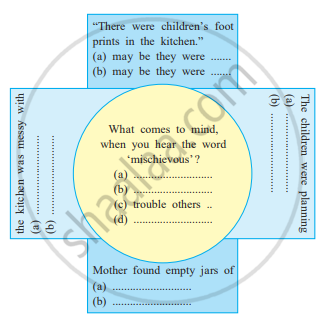
Look inside your thinking hat. Read the evidence/sentences given below and offer a possible explanation of what happened in this house? Make up some questions to gather more information. Now collect all your evidences and write a story in your notebook. Give a suitable title.
Write a news report on the ‘Environment Day’ celebrated in your school.
Read the telephonic conversation between Malar and Selvi. Malar needs to leave a message for her father.
| Malar: | Hello, my name is Malar. Could I talk to Mr. Rao, please? I’m his colleague Mr. Vishvanath’s daughter. |
| Selvi: | I’m sorry, my father is out for his morning walk. Do you want to leave a message for him? |
| Malar: | Yes, please. My father had to leave for Madurai all of a sudden since my grandfather is ill. So he won’t be able to come to work for a few days. It would be really nice if your father could inform the office. |
| Selvi: | Don’t worry, I’ll leave the message for my father. |
| Malar: | Thanks a lot. |
| Selvi: | You’re welcome. |
|
This is the message that Selvi left for her father the previous day. Write a similar message based on her conversation with Malar. ______ (Date) 4.30 p.m. (Time) Dear Papa, I have my music class at 5.00 p.m. so I am leaving now. I’ve prepared tea and samosa and kept it in the kitchen. Please come and pick me up at 7 p.m. |
|
Message ______(Date) ______(Time) Dear Papa, _____________________________________________________________ |
Describe the picture in 50 words and give a suitable title. Make use of the words given below.
modern world – left alone – busy – gadgets – cell phones – ignored – feels alone – lonely – sad feeling

Create a poster for the following.
You are Raja/ Ranjani. Draft a poster to create awareness about the harmful effects of using plastics, in not more than 50 words.
The word in the sentence is jumbled. Write them in order.
I went the towards footprint large.
Let s imagine a topsy-turvy scene and describe it in the lines below.
Correct the use of the describing word in the following sentence.
I like this the best of the two.
Here is a word, morning. Now write down words related to it.

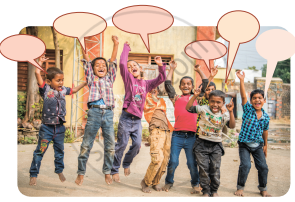
The children in the picture are watching an exciting sporting event, where their school team is winning. Suggest suitable utterances reflecting their feelings:
When and how did Bob realise that the tall man was not his friend?
State whether the following statement are true or false
Jimmy grew a little taller after he was twenty.
How would Miss Meadows usually treat Mary? How did her behavior towards the girl change that day?
Answer the following question as briefly as possible and with close reference to the relevant text.
Referring closely to the short story, The Singing Lesson relate what Basil wrote in his letter to Miss Meadows. What do you conclude about Basil from the tone and wording of the letter?
Certainly anyone who insists on condemning all lies should think about what would happen if we could reliably tell when our family, friends, colleagues, and government leaders were deceiving us. It is tempting to think that the world would become a better place without the deceptions that seem to interfere with our attempts are genuine communication. On the other hand, perhaps there is such a thing as too much honesty. - Adapted from Allison Kornet, "The Truth About Lying"
Would the world be a better place if everyone always told the complete truth? Plan and write an essay in which you develop your point of view on this issue. Support your position with reasoning and examples taken from your reading, studies, experience, or observations.
Write a short note on your mother tongue and the attempts you make to study it well.
Who is your favourite comedian?
Imagine someone has invited your family to a programme, and you were the only person at home when the invitation was given orally.
Write a note (4-5 lines) to pass on the message to the other people in your family. Or, Write an imaginary conversation in which you pass on the message to your parents.
Imagine someone has invited your family to a programme and you were the only person at home when the invitation was given orally.
Write a note (4-5 lines) to pass on the message to the other people in your family. Or, Write an imaginary conversation in which you pass on the message to your parents.
