Advertisements
Advertisements
Question
\[\lim_{x \to 1} \frac{x^3 + 3 x^2 - 6x + 2}{x^3 + 3 x^2 - 3x - 1}\]
Advertisements
Solution
Let p(x) = x3 + 3x2 \[-\] 6x + 2
p(1) = 1 + 3\[-\] 6 + 2
= 0
Now,
\[\left( x + 2 \right)\] is a factor of p(x).
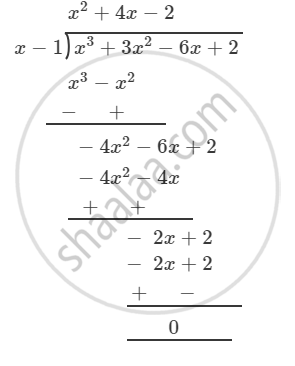
p(x) = (x\[-\] 1)(x2 + 4x \[-\] 2)
q(x) = x3 + 3x2\[-\]3x + 2
q(1) = 1 + 3 \[-\]3 \[-\]1
= 0
\[Now, \left( x + 2 \right)\] is a factor of p(x).
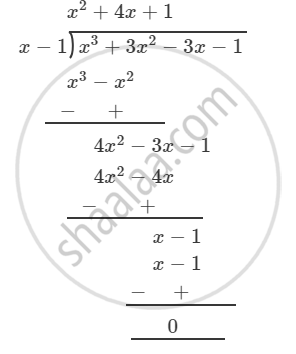
\[\Rightarrow \lim_{x \to 1} \left[ \frac{x^3 + 3 x^2 - 6x + 2}{x^3 + 3 x^2 - 3x - 1} \right]\]
\[ = \lim_{x \to 1} \left[ \frac{\left( x - 1 \right)\left( x^2 + 4x - 2 \right)}{\left( x - 1 \right)\left( x^2 + 4x + 1 \right)} \right]\]
\[ = \frac{(1 )^2 + 4 \times 1 - 2}{\left( 1 \right)^2 + 4 \times 1 + 1}\]
\[ = \frac{1 + 4 - 2}{1 + 4 + 1}\]
\[ = \frac{3}{6}\]
\[ = \frac{1}{2}\]
APPEARS IN
RELATED QUESTIONS
\[\lim_{x \to - 1/2} \frac{8 x^3 + 1}{2x + 1}\]
\[\lim_{x \to 2} \frac{x^4 - 16}{x - 2}\]
\[\lim_{x \to - 1} \frac{x^3 + 1}{x + 1}\]
\[\lim_{x \to \sqrt{2}} \frac{x^2 - 2}{x^2 + \sqrt{2}x - 4}\]
\[\lim_{x \to 1} \left( \frac{1}{x^2 + x - 2} - \frac{x}{x^3 - 1} \right)\]
\[\lim_{x \to 4} \frac{x^2 - 16}{\sqrt{x} - 2}\]
\[\lim_{x \to 2} \frac{x^3 + 3 x^2 - 9x - 2}{x^3 - x - 6}\]
\[\lim_{x \to 1} \frac{1 - x^{- 1/3}}{1 - x^{- 2/3}}\]
\[\lim_{x \to 1} \left\{ \frac{x - 2}{x^2 - x} - \frac{1}{x^3 - 3 x^2 + 2x} \right\}\]
\[\lim_{x \to 4} \frac{x^3 - 64}{x^2 - 16}\]
\[\lim_{x \to a} \frac{x^{2/3} - a^{2/3}}{x^{3/4} - a^{3/4}}\]
If \[\lim_{x \to a} \frac{x^5 - a^5}{x - a} = 405,\]find all possible values of a.
\[\lim_{n \to \infty} \left[ \frac{\left( n + 2 \right)! + \left( n + 1 \right)!}{\left( n + 2 \right)! - \left( n + 1 \right)!} \right]\]
\[\lim_{n \to \infty} \left[ \frac{1 + 2 + 3 . . . . . . n - 1}{n^2} \right]\]
\[\lim_{x \to \infty} \left[ \sqrt{x}\left\{ \sqrt{x + 1} - \sqrt{x} \right\} \right]\]
\[\lim_{x \to - \infty} \left( \sqrt{4 x^2 - 7x} + 2x \right)\]
\[\lim_{x \to 0} \frac{5 x \cos x + 3 \sin x}{3 x^2 + \tan x}\]
\[\lim_{x \to 0} \frac{x \tan x}{1 - \cos x}\]
\[\lim_{x \to 0} \frac{\sin 2x \left( \cos 3x - \cos x \right)}{x^3}\]
\[\lim_{x \to 0} \left( cosec x - \cot x \right)\]
\[\lim_{x \to \frac{\pi}{4}} \frac{\sqrt{2} - \cos x - \sin x}{\left( \frac{\pi}{4} - x \right)^2}\]
\[\lim_{x \to \frac{\pi}{4}} \frac{1 - \sin 2x}{1 + \cos 4x}\]
\[\lim_{x \to \frac{\pi}{4}} \frac{{cosec}^2 x - 2}{\cot x - 1}\]
\[\lim_{n \to \infty} \left( 1 + \frac{x}{n} \right)^n\]
Write the value of \[\lim_{x \to 1^-} x - \left[ x \right] .\]
Write the value of \[\lim_{x \to 1^-} x - \left[ x \right] .\]
Write the value of \[\lim_{x \to 2} \frac{\left| x - 2 \right|}{x - 2} .\]
\[\lim_{n \to \infty} \frac{1^2 + 2^2 + 3^2 + . . . + n^2}{n^3}\]
If \[f\left( x \right) = x \sin \left( 1/x \right), x \neq 0,\] then \[\lim_{x \to 0} f\left( x \right) =\]
\[\lim_{x \to } \frac{1 - \cos 2x}{x} is\]
The value of \[\lim_{x \to \infty} \frac{\left( x + 1 \right)^{10} + \left( x + 2 \right)^{10} + . . . + \left( x + 100 \right)^{10}}{x^{10} + {10}^{10}}\] is
\[\lim_{x \to 1} \left[ x - 1 \right]\] where [.] is the greatest integer function, is equal to
Evaluate the following limits: `lim_(x -> 2)[(x^(-3) - 2^(-3))/(x - 2)]`
Evaluate the following limits: if `lim_(x -> 5)[(x^"k" - 5^"k")/(x - 5)]` = 500, find all possible values of k.
Evaluate the following Limits: `lim_(x -> "a") ((x + 2)^(5/3) - ("a" + 2)^(5/3))/(x - "a")`
Evaluate `lim_(h -> 0) ((a + h)^2 sin (a + h) - a^2 sina)/h`
