Advertisements
Advertisements
प्रश्न
\[\lim_{x \to 1} \frac{x^3 + 3 x^2 - 6x + 2}{x^3 + 3 x^2 - 3x - 1}\]
Advertisements
उत्तर
Let p(x) = x3 + 3x2 \[-\] 6x + 2
p(1) = 1 + 3\[-\] 6 + 2
= 0
Now,
\[\left( x + 2 \right)\] is a factor of p(x).
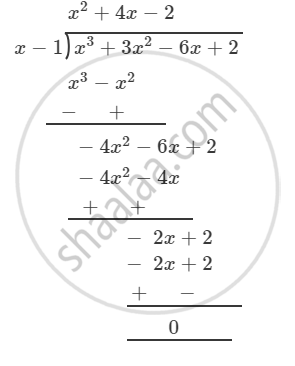
p(x) = (x\[-\] 1)(x2 + 4x \[-\] 2)
q(x) = x3 + 3x2\[-\]3x + 2
q(1) = 1 + 3 \[-\]3 \[-\]1
= 0
\[Now, \left( x + 2 \right)\] is a factor of p(x).
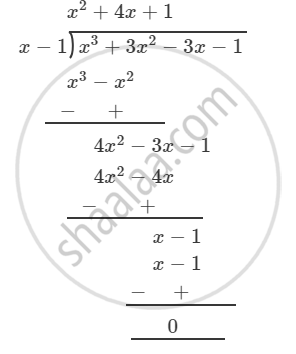
\[\Rightarrow \lim_{x \to 1} \left[ \frac{x^3 + 3 x^2 - 6x + 2}{x^3 + 3 x^2 - 3x - 1} \right]\]
\[ = \lim_{x \to 1} \left[ \frac{\left( x - 1 \right)\left( x^2 + 4x - 2 \right)}{\left( x - 1 \right)\left( x^2 + 4x + 1 \right)} \right]\]
\[ = \frac{(1 )^2 + 4 \times 1 - 2}{\left( 1 \right)^2 + 4 \times 1 + 1}\]
\[ = \frac{1 + 4 - 2}{1 + 4 + 1}\]
\[ = \frac{3}{6}\]
\[ = \frac{1}{2}\]
APPEARS IN
संबंधित प्रश्न
\[\lim_{x \to - 1}{\left( 4 x^2 + 2 \right)}\]
\[\lim_{x \to 3} \frac{x^4 - 81}{x^2 - 9}\]
\[\lim_{x \to 1} \left( \frac{1}{x^2 + x - 2} - \frac{x}{x^3 - 1} \right)\]
\[\lim_{x \to 2} \left( \frac{1}{x - 2} - \frac{2}{x^2 - 2x} \right)\]
\[\lim_{x \to 1} \frac{x^4 - 3 x^3 + 2}{x^3 - 5 x^2 + 3x + 1}\]
Evaluate the following limit:
\[\lim_{x \to 1} \frac{x^7 - 2 x^5 + 1}{x^3 - 3 x^2 + 2}\]
\[\lim_{x \to 27} \frac{\left( x^{1/3} + 3 \right) \left( x^{1/3} - 3 \right)}{x - 27}\]
\[\lim_{x \to \infty} \frac{\left( 3x - 1 \right) \left( 4x - 2 \right)}{\left( x + 8 \right) \left( x - 1 \right)}\]
\[\lim_{x \to \infty} \sqrt{x + 1} - \sqrt{x}\]
\[\lim_{n \to \infty} \frac{n^2}{1 + 2 + 3 + . . . + n}\]
\[\lim_{x \to - \infty} \left( \sqrt{x^2 - 8x} + x \right)\]
\[\lim_{x \to 0} \frac{x^2}{\sin x^2}\]
\[\lim_{x \to 0} \frac{2x - \sin x}{\tan x + x}\]
\[\lim_{x \to 0} \frac{\sin \left( 2 + x \right) - \sin \left( 2 - x \right)}{x}\]
\[\lim_{x \to 0} \frac{2 \sin x^\circ - \sin 2 x^\circ}{x^3}\]
\[\lim_{x \to \frac{\pi}{2}} \frac{\cos^2 x}{1 - \sin x}\]
\[\lim_{x \to \frac{\pi}{4}} \frac{1 - \sin 2x}{1 + \cos 4x}\]
\[\lim_{n \to \infty} \left( 1 + \frac{x}{n} \right)^n\]
\[\lim_{x \to 0^+} \left\{ 1 + \tan^2 \sqrt{x} \right\}^{1/2x}\]
\[\lim_{x \to 0} \left( \cos x \right)^{1/\sin x}\]
Write the value of \[\lim_{x \to 0^-} \left[ x \right] .\]
Write the value of \[\lim_{x \to 0^-} \frac{\sin \left[ x \right]}{\left[ x \right]} .\]
\[\lim_{x \to 0^-} \frac{\sin x}{\sqrt{x}} .\]
\[\lim_{x \to \infty} \frac{\sin x}{x}\] equals
\[\lim_{h \to 0} \left\{ \frac{1}{h\sqrt[3]{8 + h}} - \frac{1}{2h} \right\} =\]
If \[\lim_{x \to 1} \frac{x + x^2 + x^3 + . . . + x^n - n}{x - 1} = 5050\] then n equal
\[\lim_{x \to 0} \frac{8}{x^8}\left\{ 1 - \cos \frac{x^2}{2} - \cos \frac{x^2}{4} + \cos \frac{x^2}{2} \cos \frac{x^2}{4} \right\}\] is equal to
\[\lim_{x \to 0} \frac{\left| \sin x \right|}{x}\]
Evaluate the following limit:
`lim_(x -> 3) [sqrt(x + 6)/x]`
Evaluate the following limit:
`lim_(x -> 7)[((root(3)(x) - root(3)(7))(root(3)(x) + root(3)(7)))/(x - 7)]`
Evaluate the following limits: `lim_(y -> 1) [(2y - 2)/(root(3)(7 + y) - 2)]`
Evaluate `lim_(h -> 0) ((a + h)^2 sin (a + h) - a^2 sina)/h`
`1/(ax^2 + bx + c)`
Let `f(x) = {{:((k cos x)/(pi - 2x)",", "when" x ≠ pi/2),(3",", x = pi/2 "and if" f(x) = f(pi/2)):}` find the value of k.
Number of values of x where the function
f(x) = `{{:((tanxlog(x - 2))/(x^2 - 4x + 3); x∈(2, 4) - {3, π}),(1/6tanx; x = 3"," π):}`
is discontinuous, is ______.
Evaluate the following limit:
`lim_(x->3)[sqrt(x+6)/x]`
Evaluate the Following limit:
`lim_(x->7)[((root(3)(x)-root(3)(7))(root(3)(x)+root(3)(7)))/(x-7)]`
