Advertisements
Advertisements
Question
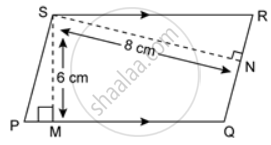
In the given figure, the perimeter of parallelogram PQRS is 42 cm. Find the lengths of PQ and PS.
Advertisements
Solution
Area of ||gm PQRS = PQ x 6
Also,
Area of ||gm PQRS = PS x 8
∴ PQ x 6 = PS x 8
⇒ PQ = `(8"PS")/(6)`
⇒ PQ = `(4"PS")/(3)` ....(i)
Perimeter of ||gm PQRS = PQ + OR + RS + PS
⇒ 42 = 2PQ + 2PS ...(opposite sides of a parallelogram are equal)
⇒ 21 = PQ + PS
⇒ `(4"PS")/(3) + "PS"` = 21 ...[From (i)]
⇒ `(4"PS" + 3"PS")/(3)`
⇒ 7PS = 63
⇒ PS = 9cm
Now,
PQ = `(4"PS")/(3)`
= `(4 xx 9)/(3)`
= 12cm
∴ PQ = 12cm and PS = 9cm.
APPEARS IN
RELATED QUESTIONS
E is the mid-point of side AB and F is the mid-point of side DC of parallelogram ABCD. Prove that AEFD is a parallelogram.
The diagonal BD of a parallelogram ABCD bisects angles B and D. Prove that ABCD is a rhombus.
In the given figure, ABCD is a parallelogram.
Prove that: AB = 2 BC.

Prove that the bisectors of opposite angles of a parallelogram are parallel.
The following figure shows a trapezium ABCD in which AB is parallel to DC and AD = BC. 
Prove that:
(i) ∠DAB = ∠CBA
(ii) ∠ADC = ∠BCD
(iii) AC = BD
(iv) OA = OB and OC = OD.
PQRS is a parallelogram. T is the mid-point of PQ and ST bisects ∠PSR.
Prove that: ∠RTS = 90°
In the Figure, ABCD is a rectangle and EFGH is a parallelogram. Using the measurements given in the figure, what is the length d of the segment that is perpendicular to `bar("HE")` and `bar("FG")`?
In parallelogram ABCD of the accompanying diagram, line DP is drawn bisecting BC at N and meeting AB (extended) at P. From vertex C, line CQ is drawn bisecting side AD at M and meeting AB (extended) at Q. Lines DP and CQ meet at O. Show that the area of triangle QPO is `9/8` of the area of the parallelogram ABCD
In the following figure, it is given that BDEF and FDCE are parallelograms. Can you say that BD = CD? Why or why not?

In the following figure, ABCD and AEFG are two parallelograms. If ∠C = 55º, determine ∠F.

