Advertisements
Advertisements
प्रश्न
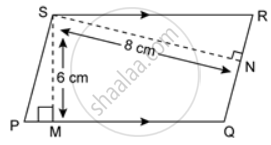
In the given figure, the perimeter of parallelogram PQRS is 42 cm. Find the lengths of PQ and PS.
Advertisements
उत्तर
Area of ||gm PQRS = PQ x 6
Also,
Area of ||gm PQRS = PS x 8
∴ PQ x 6 = PS x 8
⇒ PQ = `(8"PS")/(6)`
⇒ PQ = `(4"PS")/(3)` ....(i)
Perimeter of ||gm PQRS = PQ + OR + RS + PS
⇒ 42 = 2PQ + 2PS ...(opposite sides of a parallelogram are equal)
⇒ 21 = PQ + PS
⇒ `(4"PS")/(3) + "PS"` = 21 ...[From (i)]
⇒ `(4"PS" + 3"PS")/(3)`
⇒ 7PS = 63
⇒ PS = 9cm
Now,
PQ = `(4"PS")/(3)`
= `(4 xx 9)/(3)`
= 12cm
∴ PQ = 12cm and PS = 9cm.
APPEARS IN
संबंधित प्रश्न
The diagonal BD of a parallelogram ABCD bisects angles B and D. Prove that ABCD is a rhombus.
In the alongside diagram, ABCD is a parallelogram in which AP bisects angle A and BQ bisects angle B.

Prove that:
- AQ = BP
- PQ = CD
- ABPQ is a parallelogram.
In the given figure, ABCD is a parallelogram.
Prove that: AB = 2 BC.

Prove that the bisectors of opposite angles of a parallelogram are parallel.
PQRS is a parallelogram. T is the mid-point of PQ and ST bisects ∠PSR.
Prove that: QR = QT
PQRS is a parallelogram. T is the mid-point of PQ and ST bisects ∠PSR.
Prove that: RT bisects angle R
ABCD is a parallelogram. The bisector of ∠BAD meets DC at P, and AD is half of AB.
Prove that: ∠APB is a right angle.
In a parallelogram ABCD, E is the midpoint of AB and DE bisects angle D. Prove that:CE is the bisector of angle C and angle DEC is a right angle
Find the perimeter of the parallelogram PQRS.

Construct a parallelogram POUR in which, PO = 5.5 cm, OU = 7.2 cm and ∠O = 70°.
