Advertisements
Advertisements
Question
ABCD is a parallelogram. The bisector of ∠BAD meets DC at P, and AD is half of AB.
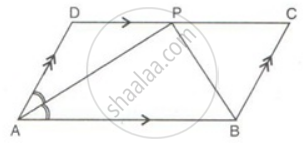
Prove that: ∠APB is a right angle.
Advertisements
Solution
∠DAP =∠PAB
∠CBP = ∠PBA
∠DAB + ∠CBA = 180° ...(adjacent angles of || gm are supplementary)
Multipying by `(1)/(2)`
`(1)/(2)∠"DAB" + (1)/(1)∠"CBA" = (1)/(2) xx 180°`
∠PAB + ∠PBA = 90°
In ΔAPB,
∠PAB + ∠PBA + ∠APB = 180°
90° + ∠APB = 180°
∠APB = 90°
Therefore, ∠APB is a right angle.
APPEARS IN
RELATED QUESTIONS
E is the mid-point of side AB and F is the mid-point of side DC of parallelogram ABCD. Prove that AEFD is a parallelogram.
The diagonal BD of a parallelogram ABCD bisects angles B and D. Prove that ABCD is a rhombus.
The alongside figure shows a parallelogram ABCD in which AE = EF = FC.
Prove that:
- DE is parallel to FB
- DE = FB
- DEBF is a parallelogram.

The following figure shows a trapezium ABCD in which AB is parallel to DC and AD = BC. 
Prove that:
(i) ∠DAB = ∠CBA
(ii) ∠ADC = ∠BCD
(iii) AC = BD
(iv) OA = OB and OC = OD.
PQRS is a parallelogram. T is the mid-point of PQ and ST bisects ∠PSR.
Prove that: RT bisects angle R
In the given figure, MP is the bisector of ∠P and RN is the bisector of ∠R of parallelogram PQRS. Prove that PMRN is a parallelogram.
In a parallelogram ABCD, E is the midpoint of AB and DE bisects angle D. Prove that:CE is the bisector of angle C and angle DEC is a right angle
In the Figure, ABCD is a rectangle and EFGH is a parallelogram. Using the measurements given in the figure, what is the length d of the segment that is perpendicular to `bar("HE")` and `bar("FG")`?
In parallelogram ABCD of the accompanying diagram, line DP is drawn bisecting BC at N and meeting AB (extended) at P. From vertex C, line CQ is drawn bisecting side AD at M and meeting AB (extended) at Q. Lines DP and CQ meet at O. Show that the area of triangle QPO is `9/8` of the area of the parallelogram ABCD
In the following figure, it is given that BDEF and FDCE are parallelograms. Can you say that BD = CD? Why or why not?

