Advertisements
Advertisements
Question
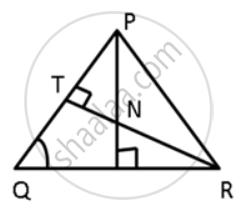
In the given figure, ∠QPR = 50° and ∠PQR = 60°. Show that : PN < RN
Advertisements
Solution
In the given ΔPQR,
PS < PR .....(Of all the straight lines that can be drawn to a given straight line from a point outside it, the perpendicular is the shortest)
PN < PR ....(i) (∵ PN < PS)
Also,
RT < PR .....(Of all the straight lines that can be drawn to a given straight line from a point outside it, the perpendicular is the shortest)
RN < PR .....(ii) (∵ RN < RT)
Dividing (i) bt (ii),
`"PN"/"RN" < "PR"/"PR"`
`"PN"/"RN" < 1`
PN < RN.
APPEARS IN
RELATED QUESTIONS
Show that in a right angled triangle, the hypotenuse is the longest side.
In the given figure sides AB and AC of ΔABC are extended to points P and Q respectively. Also, ∠PBC < ∠QCB. Show that AC > AB.

In a triangle PQR; QR = PR and ∠P = 36o. Which is the largest side of the triangle?
In the following figure, write BC, AC, and CD in ascending order of their lengths.
In the following figure, ∠BAC = 60o and ∠ABC = 65o.

Prove that:
(i) CF > AF
(ii) DC > DF
"Issues of caste discrimination began to be written about in many printed tracts and essays in India in the late nineteenth century." Support the statement with two suitable examples.
Prove that the hypotenuse is the longest side in a right-angled triangle.
For any quadrilateral, prove that its perimeter is greater than the sum of its diagonals.
In the given figure, ∠QPR = 50° and ∠PQR = 60°. Show that: SN < SR
Prove that in an isosceles triangle any of its equal sides is greater than the straight line joining the vertex to any point on the base of the triangle.
