Advertisements
Advertisements
Question
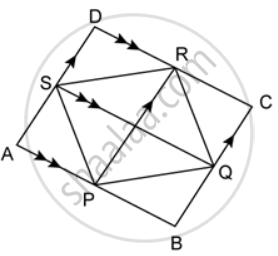
In the given figure, AB ∥ SQ ∥ DC and AD ∥ PR ∥ BC. If the area of quadrilateral ABCD is 24 square units, find the area of quadrilateral PQRS.
Advertisements
Solution
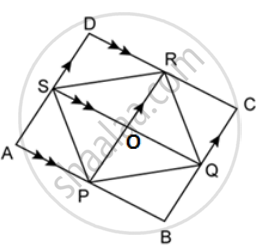
Let SQ and PR intersect at point O.
Now,
DC || SQ and RP || BCC
⇒ RC || OQ and RO || QC
⇒ QuadrilateralROQC is a parallelogram.
Similarly,
Quadrilateral ROSD, APOS and POQB are parallelograms.
ΔROQ and parallelogram ROQC are on the same base and between the same parallel lines.
∴ A(ΔROQ) = `(1)/(2)` x A(||gm ROQC) .....(i)
Similarly,
A(ΔPOQ) = `(1)/(2)` x A(||gm POQB) .....(ii)
A(ΔPOS) = `(1)/(2)` x A(||gm APOS) .....(iii)
A(ΔSOR) = `(1)/(2)` x A(||gm ROSD) .....(iv)
Adding equations (i), (ii), (iii) and (iv), we get
A(ΔROQ) + A(ΔPOQ) + A(ΔPOS) + A(ΔSOR)
= `(1)/(2)`[A(||gm ROQC) + A(||gm POQB) + A(||gm APOS) + A(||gm ROSD)]
⇒ A(||gm PQRS)
= `(1)/(2)` x A(||gm ABCD)
= `(1)/(2) xx 24`
= 12 sq. units.
APPEARS IN
RELATED QUESTIONS
ABCD is a parallelogram. P and Q are mid-points of AB and CD. Prove that APCQ is also a parallelogram.
SN and QM are perpendiculars to the diagonal PR of parallelogram PQRS.
Prove that:
(i) ΔSNR ≅ ΔQMP
(ii) SN = QM
ABCD is a rectangle with ∠ADB = 55°, calculate ∠ABD.
ABCD is a quadrilateral P, Q, R and S are the mid-points of AB, BC, CD and AD. Prove that PQRS is a parallelogram.
In a parallelogram PQRS, M and N are the midpoints of the opposite sides PQ and RS respectively. Prove that
PMRN is a parallelogram.
In the given figure, PQRS is a trapezium in which PQ ‖ SR and PS = QR. Prove that: ∠PSR = ∠QRS and ∠SPQ = ∠RQP
Prove that the diagonals of a kite intersect each other at right angles.
Prove that the diagonals of a parallelogram divide it into four triangles of equal area.
The diagonals AC and BC of a quadrilateral ABCD intersect at O. Prove that if BO = OD, then areas of ΔABC an ΔADC area equal.
In ΔPQR, PS is a median. T is the mid-point of SR and M is the mid-point of PT. Prove that: ΔPMR = `(1)/(8)Δ"PQR"`.
