Advertisements
Advertisements
Question
PQRS is a parallelogram. PQ is produced to T so that PQ = QT. Prove that PQ = QT. Prove that ST bisects QR.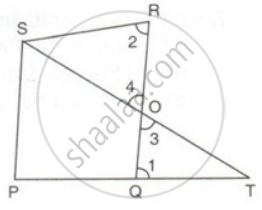
Advertisements
Solution
PQ = QT
But PQ = SR ...(PQRS is a parallelogram)
Therefore, QT = SR
In ΔSOR and ΔQAT
QT = SR
∠3 = ∠4 ...(vertically opposite angles)
∠1 = ∠2 ...(alternate angles since PQ || SR)
Therefore, ΔSOR ≅ ΔQAT
Hence, OS = OT and OR = OQ
Therefore, ST bisects QR.
RELATED QUESTIONS
ABCD is a rectangle with ∠ADB = 55°, calculate ∠ABD.
In a parallelogram PQRS, M and N are the midpoints of the opposite sides PQ and RS respectively. Prove that
RN and RM trisect QS.
In a parallelogram PQRS, M and N are the midpoints of the opposite sides PQ and RS respectively. Prove that
PMRN is a parallelogram.
In the given figure, PQRS is a trapezium in which PQ ‖ SR and PS = QR. Prove that: ∠PSR = ∠QRS and ∠SPQ = ∠RQP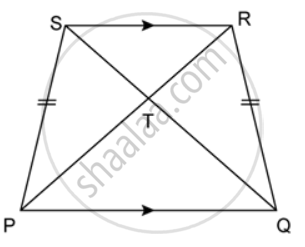
Prove that the diagonals of a kite intersect each other at right angles.
Prove that the diagonals of a square are equal and perpendicular to each other.
Prove that the diagonals of a parallelogram divide it into four triangles of equal area.
PQRS is a parallelogram and O is any point in its interior. Prove that: area(ΔPOQ) + area(ΔROS) - area(ΔQOR) + area(ΔSOP) = `(1)/(2)`area(|| gm PQRS)
In the given figure, AB ∥ SQ ∥ DC and AD ∥ PR ∥ BC. If the area of quadrilateral ABCD is 24 square units, find the area of quadrilateral PQRS.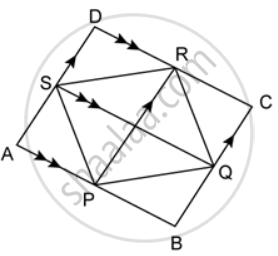
In the figure, ABCD is a parallelogram and CP is parallel to DB. Prove that: Area of OBPC = `(3)/(4)"area of ABCD"`