Advertisements
Advertisements
Question
SN and QM are perpendiculars to the diagonal PR of parallelogram PQRS.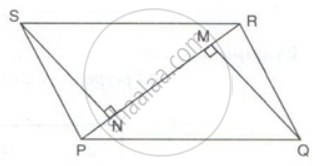
Prove that:
(i) ΔSNR ≅ ΔQMP
(ii) SN = QM
Advertisements
Solution
(i) In ΔSNR and ΔQMP
∠SNR = ∠QMP ...(right angles)
∠SRN = ∠MPQ ...(alternate angles since PQ || SR0
∴ ΔSNR ∼ ΔQMP
∠RSN = ∠PQM .........(i)
In ΔSNR and ΔQMP
∠SRN = ∠MPQ
∠RSN = ∠PQM ...(from (i))
PQ = SR ...(PQRS is a parallelogram)
Therefore, ΔSNR ≅ ΔQMP ...(ASA axiom)
(ii) Since ΔSNR ≅ ΔQMP
Hence, SN = QM.
RELATED QUESTIONS
PQRS is a parallelogram. PQ is produced to T so that PQ = QT. Prove that PQ = QT. Prove that ST bisects QR.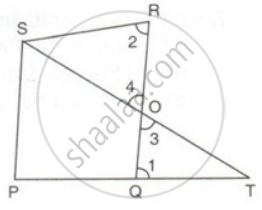
PQRS is a parallelogram. T is the mid-point of RS and M is a point on the diagonal PR such that MR = `(1)/(4)"PR"`. TM is joined and extended to cut QR at N. Prove that QN = RN.
In a parallelogram PQRS, M and N are the midpoints of the opposite sides PQ and RS respectively. Prove that
RN and RM trisect QS.
In a parallelogram PQRS, M and N are the midpoints of the opposite sides PQ and RS respectively. Prove that
PMRN is a parallelogram.
ABCD is a trapezium in which side AB is parallel to side DC. P is the mid-point of side AD. IF Q is a point on the Side BC such that the segment PQ is parallel to DC, prove that PQ = `(1)/(2)("AB" + "DC")`.
In the given figure, PQRS is a parallelogram in which PA = AB = Prove that: SA ‖ QB and SA = QB.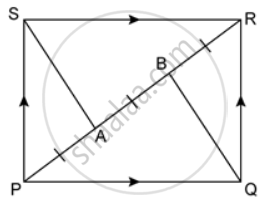
Prove that the diagonals of a parallelogram divide it into four triangles of equal area.
In the given figure, PQ ∥ SR ∥ MN, PS ∥ QM and SM ∥ PN. Prove that: ar. (SMNT) = ar. (PQRS).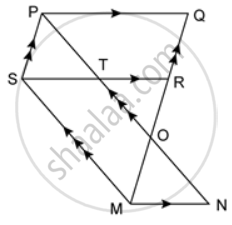
In the figure, ABCD is a parallelogram and CP is parallel to DB. Prove that: Area of OBPC = `(3)/(4)"area of ABCD"`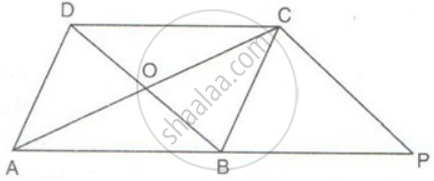
The medians QM and RN of ΔPQR intersect at O. Prove that: area of ΔROQ = area of quadrilateral PMON.
