Advertisements
Advertisements
Question
Prove that if the diagonals of a parallelogram are equal then it is a rectangle.
Advertisements
Solution

Let ABCD be a parallelogram.
In ΔABC and ΔDCB,
AB = DC ...(Opposite sides of a parallelogram are equal)
BC = BC ...(Common)
AC = DB ...(Given)
∴ ΔABC ≅ ΔDCB ...(By SSS Congruence rule)
⇒ ∠ABC = ∠DCB
It is known that the sum of the measures of angles on the same side of transversal is 180°.
∠ABC + ∠DCB = 180° ...(AB || CD)
⇒ ∠ABC + ∠ABC = 180°
⇒ 2∠ABC = 180°
⇒ ∠ABC = 90°
Since ABCD is a parallelogram and one of its interior angles is 90°, ABCD is a rectangle.
APPEARS IN
RELATED QUESTIONS
ABCD is a rectangle with ∠ADB = 55°, calculate ∠ABD.
ABCD is a quadrilateral P, Q, R and S are the mid-points of AB, BC, CD and AD. Prove that PQRS is a parallelogram.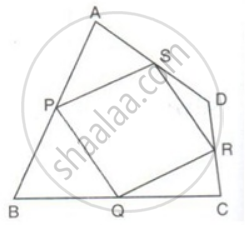
PQRS is a parallelogram. T is the mid-point of RS and M is a point on the diagonal PR such that MR = `(1)/(4)"PR"`. TM is joined and extended to cut QR at N. Prove that QN = RN.
Prove that the line segment joining the mid-points of the diagonals of a trapezium is parallel to each of the parallel sides, and is equal to half the difference of these sides.
In a parallelogram PQRS, M and N are the midpoints of the opposite sides PQ and RS respectively. Prove that
MN bisects QS.
In the given figure, PQRS is a trapezium in which PQ ‖ SR and PS = QR. Prove that: ∠PSR = ∠QRS and ∠SPQ = ∠RQP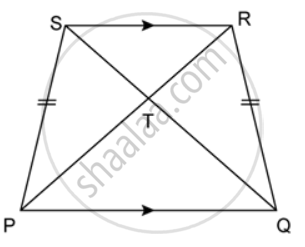
Prove that the diagonals of a kite intersect each other at right angles.
Prove that the diagonals of a parallelogram divide it into four triangles of equal area.
PQRS is a parallelogram and O is any point in its interior. Prove that: area(ΔPOQ) + area(ΔROS) - area(ΔQOR) + area(ΔSOP) = `(1)/(2)`area(|| gm PQRS)
The medians QM and RN of ΔPQR intersect at O. Prove that: area of ΔROQ = area of quadrilateral PMON.
