Advertisements
Advertisements
Question
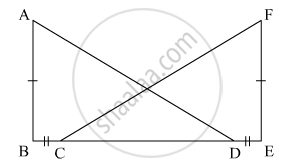
In the given figure, AB ⊥ BE and FE ⊥ BE. If BC = DE and AB = EF, then ΔABD is congruent to
Options
ΔEFC
ΔECF
ΔCEF
ΔFEC
Advertisements
Solution
ΔFEC
Explanation:
It is given that
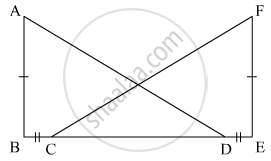
In the figure, AB ⊥ BE, FE ⊥ BE
Now, BC = DE.
Adding DC to both the sides, we get,
⇒ BC + DC = DE + DC
⇒ BD = CE
In ΔABD and ΔCEF
BD = CE (Proved)
AB = FE (Given)
∠ABD = ∠FEC (Each 90°)
∴ ΔABD ≅ ΔFEC by SAS congruence rule.
APPEARS IN
RELATED QUESTIONS
BD and CE are bisectors of ∠B and ∠C of an isosceles ΔABC with AB = AC. Prove that BD = CE.
In two right triangles one side an acute angle of one are equal to the corresponding side and angle of the othe Prove that the triangles are congruent.
ΔPQR and ΔABC is not congruent to ΔRPQ, then which of the following is not true:
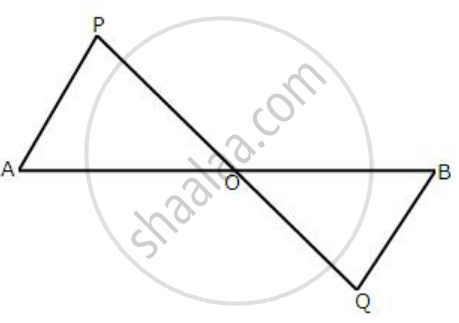
In the following diagram, AP and BQ are equal and parallel to each other.
Prove that:
- ΔAOP ≅ ΔBOQ.
- AB and PQ bisect each other.
In the following figure, OA = OC and AB = BC.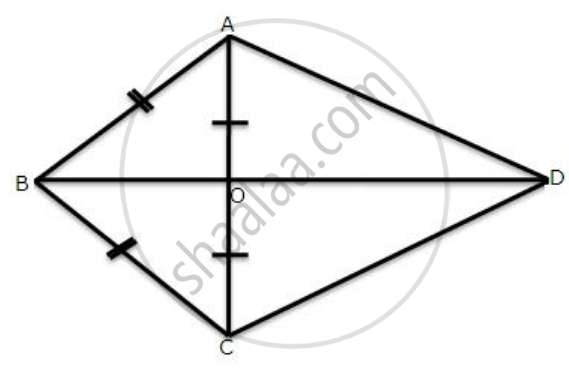
Prove that:
(i) ∠AOB = 90o
(ii) ΔAOD ≅ ΔCOD
(iii) AD = CD
State, whether the pairs of triangles given in the following figures are congruent or not:


State, whether the pairs of triangles given in the following figures are congruent or not:
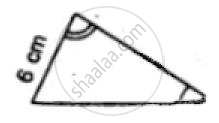
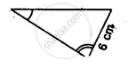
In the given figure P is a midpoint of chord AB of the circle O. prove that OP ^ AB.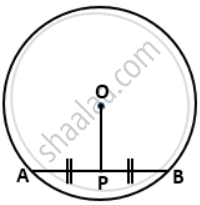
In ΔABC, AB = AC. D is a point in the interior of the triangle such that ∠DBC = ∠DCB. Prove that AD bisects ∠BAC of ΔABC.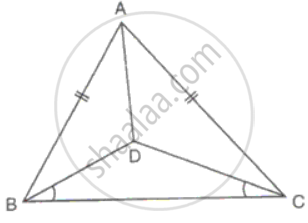
The congruent figures super impose each other completely.
