Advertisements
Advertisements
प्रश्न
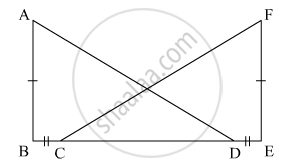
In the given figure, AB ⊥ BE and FE ⊥ BE. If BC = DE and AB = EF, then ΔABD is congruent to
विकल्प
ΔEFC
ΔECF
ΔCEF
ΔFEC
Advertisements
उत्तर
ΔFEC
Explanation:
It is given that
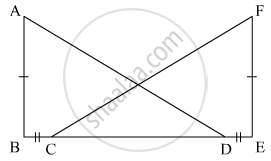
In the figure, AB ⊥ BE, FE ⊥ BE
Now, BC = DE.
Adding DC to both the sides, we get,
⇒ BC + DC = DE + DC
⇒ BD = CE
In ΔABD and ΔCEF
BD = CE (Proved)
AB = FE (Given)
∠ABD = ∠FEC (Each 90°)
∴ ΔABD ≅ ΔFEC by SAS congruence rule.
APPEARS IN
संबंधित प्रश्न
If ΔABC ≅ ΔFED under the correspondence ABC ↔ FED, write all the Corresponding congruent parts of the triangles.
Which of the following is not a criterion for congruence of triangles?
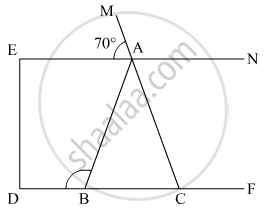
In the given figure, if AE || DC and AB = AC, the value of ∠ABD is
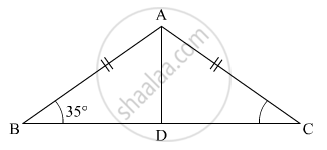
ABC is an isosceles triangle such that AB = AC and AD is the median to base BC. Then, ∠BAD =
Observe the information shown in pair of triangle given below. State the test by which the two triangles are congruent. Write the remaining congruent parts of the triangles.
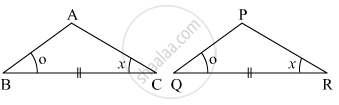
From the information shown in the figure,
In ΔABC and ΔPQR
∠ABC ≅ ∠PQR
seg BC ≅ seg QR
∠ACB ≅ ∠PRQ
∴ ΔABC ≅ ΔPQR ...`square` test
∴ ∠BAC ≅ `square` ...corresponding angles of congruent triangles.
`{:("seg AB" ≅ square),("and" square ≅ "seg PR"):}}` ...corresponding sides of congruent triangles
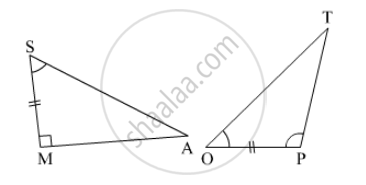
In the pair of triangles in the following figure, parts bearing identical marks are congruent. State the test and the correspondence of vertices by the triangle in pairs is congruent.
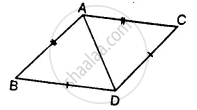
In the given figure, prove that: ∆ ABD ≅ ∆ ACD
Which of the following pairs of triangles are congruent? Give reasons
ΔABC;(BC = 5cm,AC = 6cm,∠C = 80°);
ΔXYZ;(XZ = 6cm,XY = 5cm,∠X = 70°).
Prove that in an isosceles triangle the altitude from the vertex will bisect the base.
“If two sides and an angle of one triangle are equal to two sides and an angle of another triangle, then the two triangles must be congruent.” Is the statement true? Why?
