Advertisements
Advertisements
प्रश्न
In the following diagram, ABCD is a square and APB is an equilateral triangle.
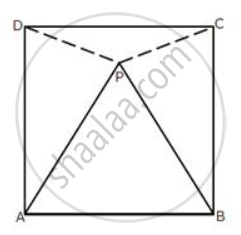
(i) Prove that: ΔAPD≅ ΔBPC
(ii) Find the angles of ΔDPC.
Advertisements
उत्तर
Given: ABCD is a Square and ΔAPB is an equilateral triangle.
We need to
(i) Prove that: ΔAPD≅ ΔBPC
(ii) Find the angles of ΔDPC
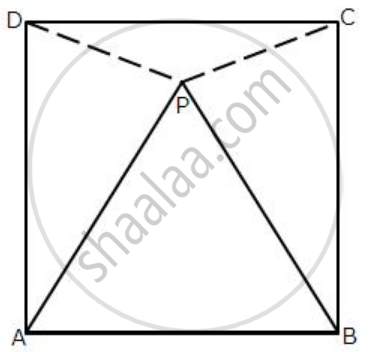
Proof:
Since AB side is present in both square & equilateral triangle
AP = PB = AB =AD = CD = BC
(i) In ΔBPC,
BP = BC
∴ ∠BPC = ∠PCB
∠BPC + ∠PCB + 30° = 180°
∠BPC + ∠BPC = 150°
2∠BPC = ` (150°)/2 = 75°`
∴ ∠BPC = ∠PCB = 75°
∠ADP = ∠DPA = 75° ...[C.P.C.T.C]
(ii) In DPC
∠DCP = 90° - 75° = 15°
∠PDC = 90° - 75° = 15°
∠DPC = 180° - (15° + 15°)
∠DPC = 150°
APPEARS IN
संबंधित प्रश्न
In ΔPQR ≅ ΔEFD then ED =
In the given figure, if AC is bisector of ∠BAD such that AB = 3 cm and AC = 5 cm, then CD =

ABC is an isosceles triangle such that AB = AC and AD is the median to base BC. Then, ∠BAD =

If the following pair of the triangle is congruent? state the condition of congruency:
In ΔABC and ΔPQR, BC = QR, ∠A = 90°, ∠C = ∠R = 40° and ∠Q = 50°.
In the following figure, OA = OC and AB = BC.

Prove that: AD = CD
State, whether the pairs of triangles given in the following figures are congruent or not:

State, whether the pairs of triangles given in the following figures are congruent or not:

In a triangle ABC, if D is midpoint of BC; AD is produced upto E such as DE = AD, then prove that:
a. DABD andDECD are congruent.
b. AB = EC
c. AB is parallel to EC
AD and BE are altitudes of an isosceles triangle ABC with AC = BC. Prove that AE = BD.
PQRS is a quadrilateral and T and U are points on PS and RS respectively such that PQ = RQ, ∠PQT = ∠RQU and ∠TQS = ∠UQS. Prove that QT = QU.
