Advertisements
Advertisements
प्रश्न
In the given figure, AB ⊥ BE and FE ⊥ BE. If BC = DE and AB = EF, then ΔABD is congruent to
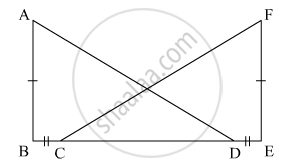
पर्याय
ΔEFC
ΔECF
ΔCEF
ΔFEC
Advertisements
उत्तर
ΔFEC
Explanation:
It is given that
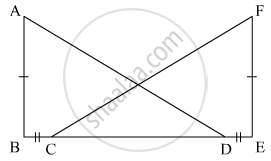
In the figure, AB ⊥ BE, FE ⊥ BE
Now, BC = DE.
Adding DC to both the sides, we get,
⇒ BC + DC = DE + DC
⇒ BD = CE
In ΔABD and ΔCEF
BD = CE (Proved)
AB = FE (Given)
∠ABD = ∠FEC (Each 90°)
∴ ΔABD ≅ ΔFEC by SAS congruence rule.
APPEARS IN
संबंधित प्रश्न
In the following example, a pair of triangles is shown. Equal parts of triangles in each pair are marked with the same sign. Observe the figure and state the test by which the triangle in each pair are congruent.
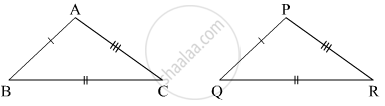
By ______ test
Δ ABC ≅ ΔPQR
In the following example, a pair of triangles is shown. Equal parts of triangle in each pair are marked with the same sign. Observe the figure and state the test by which the triangle in each pair are congruent.
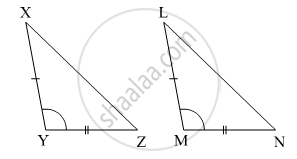
By ______ test
ΔXYZ ≅ ΔLMN
In ΔTPQ, ∠T = 65°, ∠P = 95° which of the following is a true statement?
On the sides AB and AC of triangle ABC, equilateral triangle ABD and ACE are drawn. Prove that:
- ∠CAD = ∠BAE
- CD = BE
State, whether the pairs of triangles given in the following figures are congruent or not:
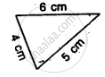
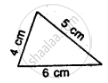
State, whether the pairs of triangles given in the following figures are congruent or not:
Δ ABC in which AB = 2 cm, BC = 3.5 cm and ∠C = 80° and Δ DEF in which DE = 2 cm, DF = 3.5 cm and ∠D = 80°.
In ΔABC, X and Y are two points on AB and AC such that AX = AY. If AB = AC, prove that CX = BY.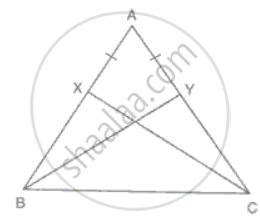
Prove that in an isosceles triangle the altitude from the vertex will bisect the base.
In triangles ABC and PQR, ∠A = ∠Q and ∠B = ∠R. Which side of ∆PQR should be equal to side BC of ∆ABC so that the two triangles are congruent? Give reason for your answer.
Without drawing the triangles write all six pairs of equal measures in the following pairs of congruent triangles.
∆XYZ ≅ ∆MLN
