Advertisements
Advertisements
प्रश्न
In the given figure, if AC is bisector of ∠BAD such that AB = 3 cm and AC = 5 cm, then CD =
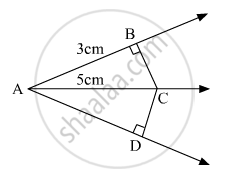
पर्याय
2 cm
3 cm
4 cm
5 cm
Advertisements
उत्तर
It is given that
AC, is bisector of ∠BAD
∠BAC = ∠CAD
AB = 3cm
AC =5cm
We are to find the side CD
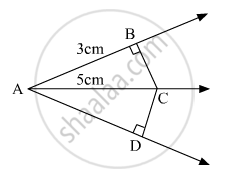
Analyze the figure and conclude that
CD = BC (As in the two triangles are congruent)
In ΔABC
`BC = sqrt25- 9`
`= sqrt 16`
= 4
So
BC = CD
⇒ CD = 4
Hence (c) CD = 4.
APPEARS IN
संबंधित प्रश्न
In a squared sheet, draw two triangles of equal areas such that
The triangles are not congruent.
What can you say about their perimeters?
If ABC and DEF are two triangles such that ΔABC \[\cong\] ΔFDE and AB = 5cm, ∠B = 40°
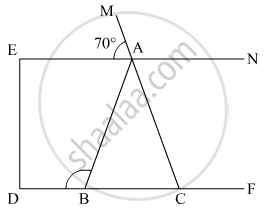
In the given figure, if AE || DC and AB = AC, the value of ∠ABD is
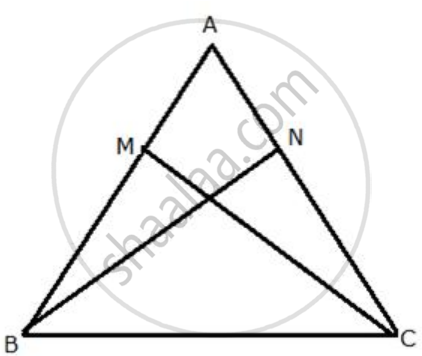
The following figure has shown a triangle ABC in which AB = AC. M is a point on AB and N is a point on AC such that BM = CN.
Prove that: (i) BN = CM (ii) ΔBMC ≅ ΔCNB
Which of the following pairs of triangles are congruent? Give reasons
ΔABC;(∠B = 90°,BC = 6cm,AB = 8cm);
ΔPQR;(∠Q = 90°,PQ = 6cm,PR = 10cm).
If the given two triangles are congruent, then identify all the corresponding sides and also write the congruent angles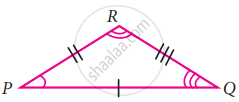
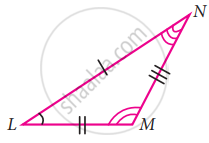
Which of the following rule is not sufficient to verify the congruency of two triangles
In triangles ABC and PQR, ∠A = ∠Q and ∠B = ∠R. Which side of ∆PQR should be equal to side BC of ∆ABC so that the two triangles are congruent? Give reason for your answer.
“If two sides and an angle of one triangle are equal to two sides and an angle of another triangle, then the two triangles must be congruent.” Is the statement true? Why?
Without drawing the triangles write all six pairs of equal measures in the following pairs of congruent triangles.
∆XYZ ≅ ∆MLN
