Advertisements
Advertisements
Question
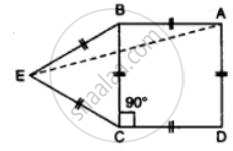
In the figure, given below, ABCD is a square, and ∆ BEC is an equilateral triangle. Find, the case:∠ABE
Advertisements
Solution
We know that the sides of a square are equal and each angle is of 90°
Three sides of an equilateral triangle are equal and each angle is of 60.
Therefore, In fig., ABCD is a square and Δ BEC is an equilateral triangle.
(i) ∠ABE = ∠ABC + ∠CBE
= 90° + 60° = 150°
(ii) But in Δ ABE
∠ABE + ∠BEA + ∠BAE = 180° ...............(Angles of a triangle)
⇒ 150° + ∠BAE + ∠BAE = 180° .............(∵ AB = BE)
⇒ 150° + 2 ∠BAE = 180°
⇒ 2 ∠BAE = 180°− 150° = 30°
∴ ∠BAE =`(30°)/2=15°`
APPEARS IN
RELATED QUESTIONS
Find the unknown angles in the given figure:
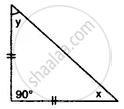
Find the unknown angles in the given figure:
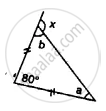
Find the unknown angles in the given figure:
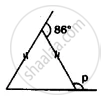
Apply the properties of isosceles and equilateral triangles to find the unknown angles in the given figure:
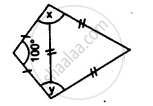
Apply the properties of isosceles and equilateral triangles to find the unknown angles in the given figure:
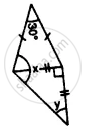
The vertical angle of an isosceles triangle is 15° more than each of its base angles. Find each angle of the triangle.
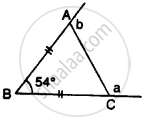
In ∆ ABC, BA and BC are produced. Find the angles a and h. if AB = BC.
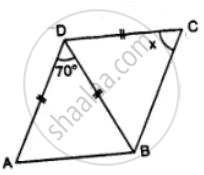
Find x in Figure Given: DA = DB = DC, BD bisects ∠ABC and∠ADB = 70°.
In the figure, AB is parallel to CD, find x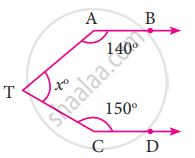
The angles of a triangle are in the ratio 1 : 2 : 3, find the measure of each angle of the triangle
