English

In the centre of a rectangular lawn of dimensions 50 m × 40 m, a rectangular pond has to be constructed so that the area of the grass surrounding the pond would be 1184 m2 - Mathematics

Advertisements
Advertisements

Question

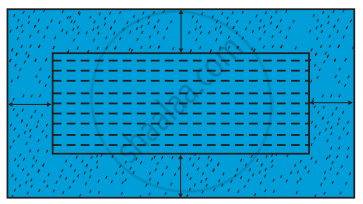
In the centre of a rectangular lawn of dimensions 50 m × 40 m, a rectangular pond has to be constructed so that the area of the grass surrounding the pond would be 1184 m2 [see figure]. Find the length and breadth of the pond.
Sum
Advertisements

Solution

Given that a rectangular pond has to be constructed in the centre of a rectangular lawn of dimensions 50 m × 40 m

So, the distance between pond and lawn would be same around the pond.

Say x m.
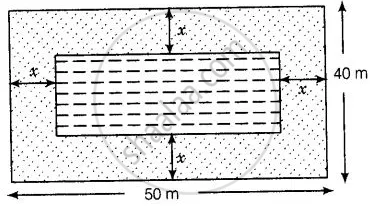
Now, length of rectangular lawn (l1) = 50 m and breadth of rectangular lawn (b1) = 40 m

Length of rectangular pond (l2)= 50 – (x + x) = 50 – 2x

And breadth of rectangular pond (b2) = 40 – (x + x)= 40 – 2x

Also, area of the grass surrounding the pond = 1184 m2

Area of rectangular lawn – Area of rectangular pond = Area of grass surrounding the pond

l1 × b1 – l2 × b2 = 1184   ......[∵ Area of rectangle = length × breadth]

⇒ 50 × 40 – (50 – 2x)(40 – 2x) = 1184

⇒ 2000 – (2000 – 80x – 100x + 4x2) = 1184

⇒ 80x + 100x – 4x2 = 1184

⇒ 4x2 – 180x + 1184 = 0

⇒ x2 – 45x + 296 = 0   

⇒ x2 – 37x – 8x + 296 = 0  ....[By splitting the middle term]

⇒ x(x – 37) – 8(x – 37) = 0

⇒ (x – 37)(x – 8) = 0

∴ x = 8

At x = 37,

Length and Breadth of pond are – 24 and – 34, respectively but length and breadth cannot be negative.

So, x = 37 cannot be possible

∴ Length of pond = 50 – 2x

= 50 – 2(8)

= 50 – 16

= 34 m

And breadth of pond = 40 – 2x

= 40 – 2(8)

= 40 – 16

= 24 m 

Hence, required length and breadth of pond are 34 m and 24 m, respectively.

shaalaa.com
  Is there an error in this question or solution?
Chapter 4: Quadatric Euation - Exercise 4.4 [Page 43]

APPEARS IN

NCERT Exemplar Mathematics [English] Class 10
Chapter 4 Quadatric Euation
Exercise 4.4 | Q 7 | Page 43

RELATED QUESTIONS

Solve for x

`(2x)/(x-3)+1/(2x+3)+(3x+9)/((x-3)(2x+3)) = 0, x!=3,`


Solve  (i) x2  + 3x – 18 = 0

(ii) (x – 4) (5x + 2) = 0

(iii) 2x2 + ax – a2 = 0; where ‘a’ is a real number


Solve for x :

`1/(2x - 3) + 1/(x - 5) = 1 1/9 , X != 3/2, 5`


The sum of the squares of the two consecutive odd positive integers as 394. Find them.


The sum of the squares of two numbers as 233 and one of the numbers as 3 less than twice the other number find the numbers.


The difference of squares of two number is 88. If the larger number is 5 less than twice the smaller number, then find the two numbers.


The sum of natural number and its positive square root is 132. Find the number. 


The difference of two natural numbers is 5 and the difference of heir reciprocals is `5/14`Find the numbers 


The sum of the squares two consecutive multiples of 7 is 1225. Find the multiples. 


Solve the following quadratic equations by factorization: \[\frac{2}{x + 1} + \frac{3}{2(x - 2)} = \frac{23}{5x}; x \neq 0, - 1, 2\]


If a and b can take values 1, 2, 3, 4. Then the number of the equations of the form ax2 +bx + 1 = 0 having real roots is


A two digit number is such that its product of its digit is 18. When 63 is subtracted from the number, the digits interchange their places. Find the number.


Solve equation using factorisation method:

`(x - 3)/(x + 3) + (x + 3)/(x - 3) = 2 1/2`


Solve the following quadratic equation by factorisation method:
`x/(x + 1) + (x + 1)/x = (34)/(15') x ≠ 0, x ≠ -1`


Solve for x:
`(x + 1/x)^2 - (3)/(2)(x - 1/x)-4` = 0.


In each of the following, determine whether the given values are solution of the given equation or not:
`x^2 - sqrt(2) - 4 = 0; x = -sqrt(2), x = -2sqrt(2)`


Solve the following equation by factorization

`sqrt(x(x - 7)) = 3sqrt(2)`


Find two consecutive integers such that the sum of their squares is 61


Car A travels ‘x’ km for every litre of petrol, while car B travels (x + 5) km for every litre of petrol.

  1. Write down the number of litres of petrol used by car A and car B in covering a distance of 400 km.
  2. If car A uses 4 litres of petrol more than car B in covering 400 km. write down an equation, in A and solve it to determine the number of litres of petrol used by car B for the journey.

A natural number, when increased by 12, equals 160 times its reciprocal. Find the number.


Share
Notifications

Englishहिंदीमराठी


      Forgot password?
Use app×