हिंदी

In the centre of a rectangular lawn of dimensions 50 m × 40 m, a rectangular pond has to be constructed so that the area of the grass surrounding the pond would be 1184 m2 - Mathematics

Advertisements
Advertisements

प्रश्न

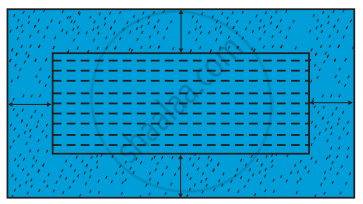
In the centre of a rectangular lawn of dimensions 50 m × 40 m, a rectangular pond has to be constructed so that the area of the grass surrounding the pond would be 1184 m2 [see figure]. Find the length and breadth of the pond.
योग
Advertisements

उत्तर

Given that a rectangular pond has to be constructed in the centre of a rectangular lawn of dimensions 50 m × 40 m

So, the distance between pond and lawn would be same around the pond.

Say x m.
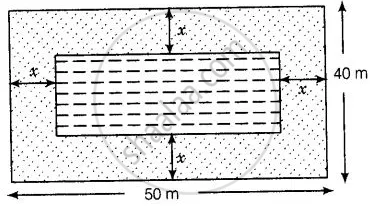
Now, length of rectangular lawn (l1) = 50 m and breadth of rectangular lawn (b1) = 40 m

Length of rectangular pond (l2)= 50 – (x + x) = 50 – 2x

And breadth of rectangular pond (b2) = 40 – (x + x)= 40 – 2x

Also, area of the grass surrounding the pond = 1184 m2

Area of rectangular lawn – Area of rectangular pond = Area of grass surrounding the pond

l1 × b1 – l2 × b2 = 1184   ......[∵ Area of rectangle = length × breadth]

⇒ 50 × 40 – (50 – 2x)(40 – 2x) = 1184

⇒ 2000 – (2000 – 80x – 100x + 4x2) = 1184

⇒ 80x + 100x – 4x2 = 1184

⇒ 4x2 – 180x + 1184 = 0

⇒ x2 – 45x + 296 = 0   

⇒ x2 – 37x – 8x + 296 = 0  ....[By splitting the middle term]

⇒ x(x – 37) – 8(x – 37) = 0

⇒ (x – 37)(x – 8) = 0

∴ x = 8

At x = 37,

Length and Breadth of pond are – 24 and – 34, respectively but length and breadth cannot be negative.

So, x = 37 cannot be possible

∴ Length of pond = 50 – 2x

= 50 – 2(8)

= 50 – 16

= 34 m

And breadth of pond = 40 – 2x

= 40 – 2(8)

= 40 – 16

= 24 m 

Hence, required length and breadth of pond are 34 m and 24 m, respectively.

shaalaa.com
  क्या इस प्रश्न या उत्तर में कोई त्रुटि है?
अध्याय 4: Quadatric Euation - Exercise 4.4 [पृष्ठ ४३]

APPEARS IN

एनसीईआरटी एक्झांप्लर Mathematics [English] Class 10
अध्याय 4 Quadatric Euation
Exercise 4.4 | Q 7 | पृष्ठ ४३

संबंधित प्रश्न

Solve for x :

`1/(2x - 3) + 1/(x - 5) = 1 1/9 , X != 3/2, 5`


The product of two successive integral multiples of 5 is 300. Determine the multiples.


Rs. 9000 were divided equally among a certain number of persons. Had there been 20 more persons, each would have got Rs. 160 less. Find the original number of persons.


`x^2-6x+3=0` 


Solve for x: `3x^2-2sqrt3x+2=0`


Solve the following quadratic equation by factorisation.
3x2 - 2√6x + 2 = 0


Solve the following quadratic equations by factorization: \[\frac{1}{2a + b + 2x} = \frac{1}{2a} + \frac{1}{b} + \frac{1}{2x}\]


Show that x = −2 is a solution of 3x2 + 13x + 14 = 0.


Solve the following equation: `7"x" + 3/"x" = 35  3/5`


A two digit number is such that the product of the digits is 14. When 45 is added to the number, then the digit are reversed. Find the number.


A two digit number is such that the product of the digits is 14. When 45 is added to the number, then the digit are reversed. Find the number.


The sum of the square of 2 positive integers is 208. If the square of larger number is 18 times the smaller number, find the numbers.


Solve the following quadratic equation by factorisation:
x2 - 3x - 10 = 0


Solve the following equation by factorization.

a2x2 + 2ax + 1 = 0, a ≠ 0


In a certain positive fraction, the denominator is greater than the numerator by 3. If 1 is subtracted from both the numerator and denominator, the fraction is decreased by `(1)/(14)`. Find the fraction.


A rectangular garden 10 m by 16 m is to be surrounded by a concrete walk of uniform width. Given that the area of the walk is 120 square metres, assuming the width of the walk to be x, form an equation in x and solve it to find the value of x.


A piece of cloth costs Rs. 300. If the piece was 5 metres longer and each metre of cloth costs Rs. 2 less, the cost of the piece would have remained unchanged. How long is the original piece of cloth and what is the rate per metre?


Car A travels ‘x’ km for every litre of petrol, while car B travels (x + 5) km for every litre of petrol.

  1. Write down the number of litres of petrol used by car A and car B in covering a distance of 400 km.
  2. If car A uses 4 litres of petrol more than car B in covering 400 km. write down an equation, in A and solve it to determine the number of litres of petrol used by car B for the journey.

Complete the following activity to solve the given quadratic equation by factorization method.

Activity: x2 + 8x – 20 = 0

x2 + ( __ ) – 2x – 20 = 0

x (x + 10) – ( __ ) (x + 10) = 0

(x + 10) ( ____ ) = 0

x = ___ or x = 2


(x – 3) (x + 5) = 0 gives x equal to ______.


Share
Notifications

Englishहिंदीमराठी


      Forgot password?
Use app×