Advertisements
Advertisements
Question
In problems 1 – 6, using the table estimate the value of the limit
`lim_(x -> 2) (x - 2)/(x^2 - 4)`
| x | 1.9 | 1.99 | 1.999 | 2.001 | 2.01 | 2.1 |
| f(x) | 0.25641 | 0.25062 | 0.250062 | 0.24993 | 0.24937 | 0.24390 |
Advertisements
Solution
`lim_(x -> 2) (x - 2)/(x^2 - 4) = lim_(x -> 2) (x - 2)/((x + 2)(x - 2))`
= `lim_(x -> 2) 1/((x + 2))`
| x | 1.9 | 1.99 | 1.999 | 2.001 | 2.01 | 2.1 |
| f(x) |
`1/(1.9 + 2)` = `1/3.9` = 0.256 |
`1/(1.99 + 2)` = `1/3.99` = 0.251 |
`1/(1.999 + 2)` = `1/3.999` = 0.250 |
`1/(2.001 + 2)` = `1/4.001` = 0.249 |
`1/(2.01 + 2)` = `1/4.01` = 0.249 |
`1/(2.1 + 2)` = `1/4.1` = 0.244 |
`lim_(x -> 2) (x - 2)/(x^2 - 4) = lim_(x -> 2) 11/(x + 2)`
= `1/(2 + 2)`
= `1/4`
= 0.25
APPEARS IN
RELATED QUESTIONS
Evaluate the following limit:
`lim_(y -> -3) [(y^5 + 243)/(y^3 + 27)]`
Evaluate the following limit :
`lim_(x -> 7) [(x^3 - 343)/(sqrt(x) - sqrt(7))]`
Evaluate the following limit :
`lim_(x -> 1) [(x + x^3 + x^5 + ... + x^(2"n" - 1) - "n")/(x - 1)]`
In the following example, given ∈ > 0, find a δ > 0 such that whenever, |x – a| < δ, we must have |f(x) – l| < ∈.
`lim_(x -> -3) (3x + 2)` = – 7
In problems 1 – 6, using the table estimate the value of the limit
`lim_(x -> 0) (cos x - 1)/x`
| x | – 0.1 | – 0.01 | – 0.001 | 0.0001 | 0.01 | 0.1 |
| f(x) | 0.04995 | 0.0049999 | 0.0004999 | – 0.0004999 | – 0.004999 | – 0.04995 |
In exercise problems 7 – 15, use the graph to find the limits (if it exists). If the limit does not exist, explain why?
`lim_(x -> 1) f(x)` where `f(x) = {{:(x^2 + 2",", x ≠ 1),(1",", x = 1):}`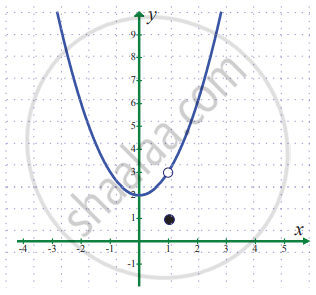
In exercise problems 7 – 15, use the graph to find the limits (if it exists). If the limit does not exist, explain why?
`lim_(x -> 5) |x - 5|/(x - 5)`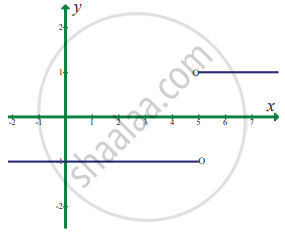
Evaluate the following limits:
`lim_(x - 0) (sqrt(1 + x^2) - 1)/x`
Evaluate the following limits:
`lim_(x -> oo) (x^4 - 5x)/(x^2 - 3x + 1)`
Show that `lim_("n" -> oo) (1 + 2 + 3 + ... + "n")/(3"n"^2 + 7n" + 2) = 1/6`
Evaluate the following limits:
`lim_(x -> 0) (1 - cos^2x)/(x sin2x)`
Evaluate the following limits:
`lim_(x - oo){x[log(x + "a") - log(x)]}`
Evaluate the following limits:
`lim_(x -> 0) (sqrt(2) - sqrt(1 + cosx))/(sin^2x)`
Choose the correct alternative:
`lim_(x -> 0) sqrt(1 - cos 2x)/x`
Choose the correct alternative:
`lim_(x -> 0) (x"e"^x - sin x)/x` is
Choose the correct alternative:
`lim_(x -> oo) (1/"n"^2 + 2/"n"^2 + 3/"n"^2 + ... + "n"/"n"^2)` is
`lim_(x -> 0) ((2 + x)^5 - 2)/((2 + x)^3 - 2)` = ______.
If `lim_(x -> 1) (x + x^2 + x^3|+ .... + x^n - n)/(x - 1)` = 820, (n ∈ N) then the value of n is equal to ______.
The value of `lim_(x→0)(sin(ℓn e^x))^2/((e^(tan^2x) - 1))` is ______.
