Advertisements
Advertisements
Question
Evaluate : `lim_(x -> 3) (x^2 - 9)/(x - 3)` if it exists by finding `f(3^-)` and `f(3^+)`
Advertisements
Solution
`lim_(x -> 3) (x^2 - 9)/(x - 3) = lim_(x - 3^-) ((x + 3)(x - 3))/(x - 3)`
= `lim_(x -> 3^-) (x + 3)`
`lim_(x -> 3) (x^2 - 9)/(x - 3)` = 3 + 3
= 6 ........(1)
`lim_(x -> 3) (x^2 - 9)/(x - 3) = lim_(x -> 3^+) (x + 3)`
= 3 + 3
= 6 .......(2)
From equations (1) and (2) we get
`lim_(x -> 3) (x^2 - 9)/(x - 3) = lim_(x -> 3^+) (x^2 - 9)/(x - 3)` = 6
∴ `lim_(x -> 3) (x^2 - 9)/(x - 3)` = 6
APPEARS IN
RELATED QUESTIONS
Evaluate the following limit:
`lim_(z -> -5)[((1/z + 1/5))/(z + 5)]`
Evaluate the following limit:
`lim_(x -> 2)[(x^(-3) - 2^(-3))/(x - 2)]`
Evaluate the following limit :
`lim_(x -> 0)[((1 - x)^8 - 1)/((1 - x)^2 - 1)]`
Evaluate the following :
`lim_(x -> 0)[x/(|x| + x^2)]`
In problems 1 – 6, using the table estimate the value of the limit.
`lim_(x -> 2) (x - 2)/(x^2 - x - 2)`
| x | 1.9 | 1.99 | 1.999 | 2.001 | 2.01 | 2.1 |
| f(x) | 0.344820 | 0.33444 | 0.33344 | 0.333222 | 0.33222 | 0.332258 |
In exercise problems 7 – 15, use the graph to find the limits (if it exists). If the limit does not exist, explain why?
`lim_(x -> 2) f(x)` where `f(x) = {{:(4 - x",", x ≠ 2),(0",", x = 2):}`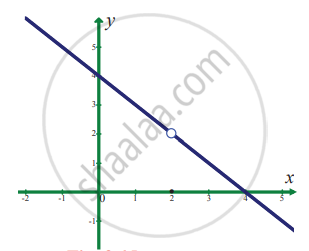
In exercise problems 7 – 15, use the graph to find the limits (if it exists). If the limit does not exist, explain why?
`lim_(x -> 0) sec x`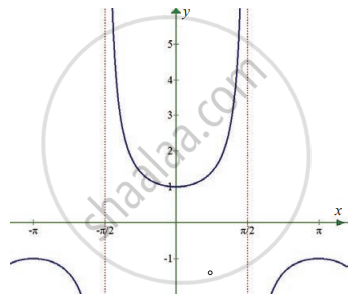
Evaluate the following limits:
`lim_(x ->) (x^"m" - 1)/(x^"n" - 1)`, m and n are integers
Evaluate the following limits:
`lim_(sqrt(x) -> 3) (x^2 - 81)/(sqrt(x) - 3)`
Evaluate the following limits:
`lim_(x -> 5) (sqrt(x + 4) - 3)/(x - 5)`
Evaluate the following limits:
`lim_(x -> oo) (1 + x - 3x^3)/(1 + x^2 +3x^3)`
Evaluate the following limits:
`lim_(x -> 0)(1 + x)^(1/(3x))`
Evaluate the following limits:
`lim_(x -> oo) ((2x^2 + 3)/(2x^2 + 5))^(8x^2 + 3)`
Evaluate the following limits:
`lim_(x -> oo) (1 + 3/x)^(x + 2)`
Evaluate the following limits:
`lim_(alpha -> 0) (sin(alpha^"n"))/(sin alpha)^"m"`
Evaluate the following limits:
`lim_(x -> pi) (1 + sinx)^(2"cosec"x)`
Choose the correct alternative:
`lim_(x -> oo) sinx/x`
Choose the correct alternative:
`lim_(x -> 0) (8^x - 4x - 2^x + 1^x)/x^2` =
Choose the correct alternative:
`lim_(x -> 3) [x]` =
