Advertisements
Advertisements
Question
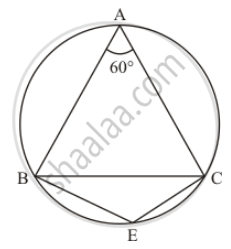
In the given figure, ΔABC is an equilateral triangle. Find m∠BEC.
Advertisements
Solution
It is given that, Δ ABC is an equilateral triangle
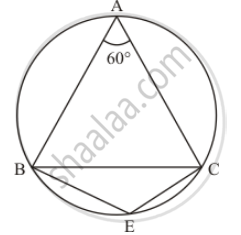
We have to find `m angle BEC`
Since Δ ABC is an equilateral triangle.
So `angle A + angle B + angle C = 180°`
And
`angle A = angleB = angleC` = 60° …… (1)
Since, quadrilateral BACE is a cyclic qualdrilateral
So , `angle A + angleE = 180°` (Sum of opposite angles of cyclic quadrilateral is 180° .)
`60° + angle E = 180°`
`angle E = 120°`
Hence
`m angle BEC = 120°`
APPEARS IN
RELATED QUESTIONS
Fill in the blanks:
A point, whose distance from the centre of a circle is greater than its radius lies in __________ of the circle. (exterior/ interior)
Fill in the blanks:
Segment of a circle is the region between an arc and __________ of the circle.
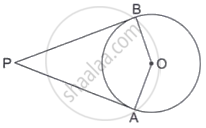
In the given figure, PA and PB are the tangent segments to a circle with centre O. Show that the points A, O, B and P are concyclic.
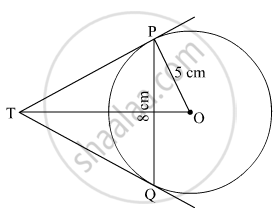
PQ is a chord of length 8 cm of a circle of radius 5 cm. The tangents at P and Q intersect at a point T. Find the lengths of TP and TQ.
Number of circles that can be drawn through three non-collinear points is
From an external point P , tangents PA = PB are drawn to a circle with centre O . If \[\angle PAB = {50}^o\] , then find \[\angle AOB\]
Use the figure given below to fill in the blank:
If PQ is 8 cm long, the length of RS = ________

The diameter of a circle is 12.6 cm. State, the length of its radius.
From a point P which is at a distance of 13 cm from the centre O of a circle of radius 5 cm, the pair of tangents PQ and PR to the circle are drawn. Then the area of the quadrilateral PQOR is ______
Which of the following describes the radius of a circle?
