Advertisements
Advertisements
प्रश्न
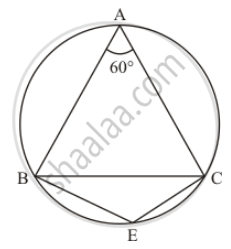
In the given figure, ΔABC is an equilateral triangle. Find m∠BEC.
Advertisements
उत्तर
It is given that, Δ ABC is an equilateral triangle
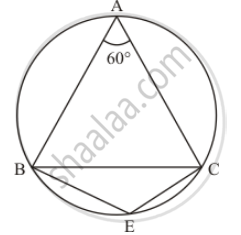
We have to find `m angle BEC`
Since Δ ABC is an equilateral triangle.
So `angle A + angle B + angle C = 180°`
And
`angle A = angleB = angleC` = 60° …… (1)
Since, quadrilateral BACE is a cyclic qualdrilateral
So , `angle A + angleE = 180°` (Sum of opposite angles of cyclic quadrilateral is 180° .)
`60° + angle E = 180°`
`angle E = 120°`
Hence
`m angle BEC = 120°`
APPEARS IN
संबंधित प्रश्न
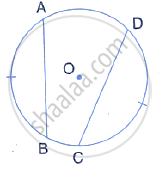
In the given figure, if arc AB = arc CD, then prove that the quadrilateral ABCD is an isosceles– trapezium (O is the centre of the circle).
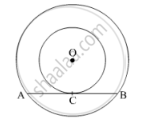
In Fig. 5, the chord AB of the larger of the two concentric circles, with centre O, touches the smaller circle at C. Prove that AC = CB.
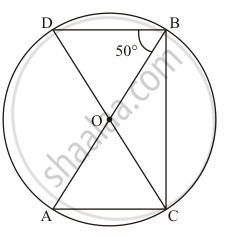
In the given figure, AB and CD are diameters of a circle with centre O. If ∠OBD = 50°, find ∠AOC.
Two concentric circles are of diameters 30 cm and 18 cm. Find the length of the chord of the larger circle which touches the smaller circle.
The figure given below shows a circle with center O in which diameter AB bisects the chord CD at point E. If CE = ED = 8 cm and EB = 4 cm,
find the radius of the circle.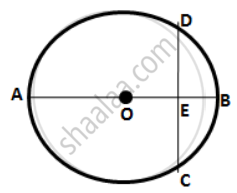
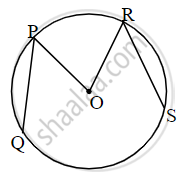
In figure, O is the centre of a circle, chord PQ ≅ chord RS. If ∠POR = 70° and (arc RS) = 80°, find
- m(arc PR)
- m(arc QS)
- m(arc QSR)
The length of tangent from an external point on a circle is always greater than the radius of the circle.
If a number of circles touch a given line segment PQ at a point A, then their centres lie on the perpendicular bisector of PQ.
If a line segment joining mid-points of two chords of a circle passes through the centre of the circle, prove that the two chords are parallel.
AB is a chord of a circle with centre O. AOC is diameter of circle, AT is a tangent at A.
Write answers of the following questions:
- Draw the figure using the given information.
- Find the measures of ∠CAT and ∠ABC with reasons.
- Whether ∠CAT and ∠ABC are congruent? Justify your answer.
