Advertisements
Advertisements
Question
In the given figure, ΔPQR is an isosceles triangle with PQ = PR and m ∠PQR = 35°. Find m ∠QSR and m ∠QTR.

Advertisements
Solution
Disclaimer: Figure given in the book was showing m∠PQR as m∠SQR. It is given that ΔPQR is an isosceles triangle with PQ = PR and m∠PQR = 35°

We have to find the m∠QSR and m∠QTR
Since ΔPQR is an isosceles triangle
So ∠PQR = ∠PRQ = 35°
Then
`angle QPR = 180° - (anglePQR + anglePRQ)`
= 180° - (35° + 35°)
=180° - 70°
=110°
Since PQTR is a cyclic quadrilateral
So
`angleP + angleT = 180°`
`angle T = 180° - 110°`
= 70°
In cyclic quadrilateral QSRT we have
`angle S + angle T` = 180°
`angle S = 180° - 70°`
= 110°
Hence,
`m angleQSR `= 110° and `angleQTR` = 70°
APPEARS IN
RELATED QUESTIONS
A circle touches the side BC of a ΔABC at a point P and touches AB and AC when produced at Q and R respectively. As shown in the figure that AQ = `1/2` (Perimeter of ΔABC).

If AB, AC, PQ are tangents in Fig. and AB = 5 cm find the perimeter of ΔAPQ.
From an external point P, tangents PA and PB are drawn to the circle with centre O. If CD is the tangent to the circle at point E and PA = 14 cm. Find the perimeter of ABCD.
Fill in the blank
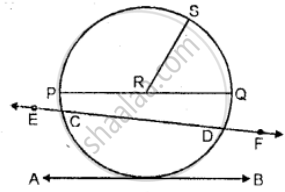
A continuous piece of a circle is ............... of the circle
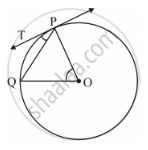
In figure 1, O is the centre of a circle, PQ is a chord and PT is the tangent at P.
If ∠POQ = 70°, then ∠TPQ is equal to
Two concentric circles are of diameters 30 cm and 18 cm. Find the length of the chord of the larger circle which touches the smaller circle.
In the given figure, PO \[\perp\] QO. The tangents to the circle at P and Q intersect at a point T. Prove that PQ and OTare right bisector of each other.

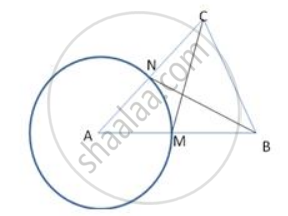
In following fig. ABC is an equilateral triangle . A circle is drawn with centre A so that ot cuts AB and AC at M and N respectively. Prove that BN = CM.

In the above figure, seg AB is a diameter of a circle with centre P. C is any point on the circle. seg CE ⊥ seg AB. Prove that CE is the geometric mean of AE and EB. Write the proof with the help of the following steps:
a. Draw ray CE. It intersects the circle at D.
b. Show that CE = ED.
c. Write the result using the theorem of the intersection of chords inside a circle. d. Using CE = ED, complete the proof.
Use the figure given below to fill in the blank:
________ is a radius of the circle.