Advertisements
Advertisements
Question
In the given cases, find the distance of each of the given points from the corresponding given plane.
Point Plane
(2, 3, – 5) x + 2y – 2z = 9
Advertisements
Solution
It is known that the distance between a point, p(x1, y1, z1), and a plane, Ax + By + Cz = D, is given by,

The given point is (2, 3, −5) and the plane is x + 2y – 2z = 9
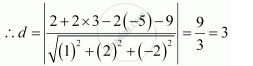
APPEARS IN
RELATED QUESTIONS
Find the equation of the plane through the line of intersection of the planes x + y + z = 1 and 2x + 3y + 4z = 5 which is perpendicular to the plane x − y + z = 0. Also find the distance of the plane, obtained above, from the origin.
In the given cases, find the distance of each of the given points from the corresponding given plane
Point Plane
(3, – 2, 1) 2x – y + 2z + 3 = 0
Find the distance of the point (−1, −5, −10) from the point of intersection of the line `vecr = 2hati -hatj + 2hatk + lambda(3hati + 4hatj + 2hatk)` and the plane `vecr.(hati -hatj + hatk) = 5`.
Show that the points (1, –1, 3) and (3, 4, 3) are equidistant from the plane 5x + 2y – 7z + 8 = 0
Find the distance of the point (1, 2, –1) from the plane x - 2y + 4z - 10 = 0 .
Write the equation of a plane which is at a distance of \[5\sqrt{3}\] units from origin and the normal to which is equally inclined to coordinate axes.
Find the distance of the point \[2 \hat{i} - \hat{j} - 4 \hat{k}\] from the plane \[\vec{r} \cdot \left( 3 \hat{i} - 4 \hat{j} + 12 \hat{k} \right) - 9 = 0 .\]
Show that the points \[\hat{i} - \hat{j} + 3 \hat{k} \text{ and } 3 \hat{i} + 3 \hat{j} + 3 \hat{k} \] are equidistant from the plane \[\vec{r} \cdot \left( 5 \hat{i} + 2 \hat{j} - 7 \hat{k} \right) + 9 = 0 .\]
Find the distance of the point (2, 3, −5) from the plane x + 2y − 2z − 9 = 0.
Show that the points (1, 1, 1) and (−3, 0, 1) are equidistant from the plane 3x + 4y − 12z + 13 = 0.
Find the equations of the planes parallel to the plane x − 2y + 2z − 3 = 0 and which are at a unit distance from the point (1, 1, 1).
Find the distance of the point (2, 3, 5) from the xy - plane.
Find an equation for the set of all points that are equidistant from the planes 3x − 4y + 12z = 6 and 4x + 3z = 7.
Find the distance between the parallel planes 2x − y + 3z − 4 = 0 and 6x − 3y + 9z + 13 = 0.
Find the equation of the plane which passes through the point (3, 4, −1) and is parallel to the plane 2x − 3y + 5z + 7 = 0. Also, find the distance between the two planes.
Find the distance between the planes \[\vec{r} \cdot \left( \hat{i} + 2 \hat{j} + 3 \hat{k} \right) + 7 = 0 \text{ and } \vec{r} \cdot \left( 2 \hat{i} + 4 \hat{j} + 6 \hat{k} \right) + 7 = 0 .\]
The distance between the planes 2x + 2y − z + 2 = 0 and 4x + 4y − 2z + 5 = 0 is
The distance of the line \[\vec{r} = 2 \hat{i} - 2 \hat{j} + 3 \hat{k} + \lambda\left( \hat{i} - \hat{j}+ 4 \hat{k} \right)\] from the plane \[\vec{r} \cdot \left( \hat{i} + 5 \hat{j} + \hat{k} \right) = 5\] is
Write the coordinates of the point which is the reflection of the point (α, β, γ) in the XZ-plane.
Find the distance of the point `4hat"i" - 3hat"j" + hat"k"` from the plane `bar"r".(2hat"i" + 3hat"j" - 6hat"k")` = 21.
If the foot of perpendicular drawn from the origin to the plane is (3, 2, 1), then the equation of plane is ____________.
Find the distance of the point (– 2, 4, – 5) from the line `(x + 3)/3 = (y - 4)/5 = (z + 8)/6`
The distance of a point P(a, b, c) from x-axis is ______.
Find the equation of the plane passing through the point (1, 1, 1) and is perpendicular to the line `("x" - 1)/3 = ("y" - 2)/0 = ("z" - 3)/4`. Also, find the distance of this plane from the origin.
Find the foot of the perpendicular from the point (1, 2, 0) upon the plane x – 3y + 2z = 9. Hence, find the distance of the point (1, 2, 0) from the given plane.
Which one of the following statements is correct for a moving body?
A metro train starts from rest and in 5 s achieves 108 km/h. After that it moves with constant velocity and comes to rest after travelling 45 m with uniform retardation. If total distance travelled is 395 m, find total time of travelling.
The equations of motion of a rocket are:
x = 2t,y = –4t, z = 4t, where the time t is given in seconds, and the coordinates of a ‘moving point in km. What is the path of the rocket? At what distances will the rocket be from the starting point O(0, 0, 0) and from the following line in 10 seconds? `vecr = 20hati - 10hatj + 40hatk + μ(10hati - 20hatj + 10hatk)`
Find the distance of the point (1, –2, 0) from the point of the line `vecr = 4hati + 2hatj + 7hatk + λ(3hati + 4hatj + 2hatk)` and the point `vecr.(hati - hatj + hatk)` = 10.
If the points (1, 1, λ) and (–3, 0, 1) are equidistant from the plane `barr*(3hati + 4hatj - 12hatk) + 13` = 0, find the value of λ.
The distance of the point `2hati + hatj - hatk` from the plane `vecr.(hati - 2hatj + 4hatk)` = 9 will be ______.
A plane passes through (1,-2,1) and is perpendicular to the planes 2x - 2y + z = 0 and x - y + 2z = 4. The distance of the point (1, 2, 2) from this plane is______ units.
