English

In the Given Cases, Find the Distance of Each of the Given Points from the Corresponding Given Plane. 2x – 3y + 6z – 2 = 0 - Mathematics

Advertisements
Advertisements

Question

In the given cases, find the distance of each of the given points from the corresponding given plane.

Point              Plane

(– 6, 0, 0)        2x – 3y + 6z – 2 = 0

Advertisements

Solution

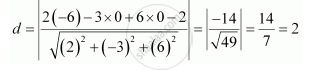
It is known that the distance between a point, p(x1y1z1), and a plane, Ax + By + Cz = D, is given by,

The given point is (−6, 0, 0) and the plane is 2x – 3y + 6z – 2 = 0
shaalaa.com
  Is there an error in this question or solution?
Chapter 11: Three Dimensional Geometry - Exercise 11.3 [Page 494]

APPEARS IN

NCERT Mathematics Part 1 and 2 [English] Class 12
Chapter 11 Three Dimensional Geometry
Exercise 11.3 | Q 14.4 | Page 494

RELATED QUESTIONS

Find the distance between the point (7, 2, 4) and the plane determined by the points A(2, 5, −3), B(−2, −3, 5) and C(5, 3, −3).


Find the equation of the planes parallel to the plane x + 2y+ 2z + 8 =0 which are at the distance of 2  units from the point (1,1, 2)


In the given cases, find the distance of each of the given points from the corresponding given plane.

Point                    Plane
(0, 0, 0)           3x – 4y + 12 z = 3


In the given cases, find the distance of each of the given points from the corresponding given plane

Point                   Plane

(3, – 2, 1)             2x – y + 2z + 3 = 0


In the given cases, find the distance of each of the given points from the corresponding given plane.

Point                 Plane

(2, 3, – 5)           x + 2y – 2z = 9


Distance between the two planes: 2x + 3y + 4z = 4 and 4x + 6y + 8z = 12 is

(A) 2 units

(B) 4 units

(C) 8 units

(D)`2/sqrt29 "units"`


Find the distance of the point (1, 2, –1) from the plane x - 2y + 4z - 10 = 0 .


Find the distance of the point  \[2 \hat{i} - \hat{j} - 4 \hat{k}\]  from the plane  \[\vec{r} \cdot \left( 3 \hat{i}  - 4 \hat{j}  + 12 \hat{k}  \right) - 9 = 0 .\]


Show that the points \[\hat{i}  - \hat{j}  + 3 \hat{k}  \text{ and }  3 \hat{i}  + 3 \hat{j}  + 3 \hat{k} \] are equidistant from the plane \[\vec{r} \cdot \left( 5 \hat{i}  + 2 \hat{j}  - 7 \hat{k}  \right) + 9 = 0 .\]


Find the distance of the point (1, −2, 3) from the plane x − y + z = 5 measured parallel to the line whose direction cosines are proportional to 2, 3, −6.


Find the distance between the parallel planes 2x − y + 3z − 4 = 0 and 6x − 3y + 9z + 13 = 0.


Find the equation of the plane which passes through the point (3, 4, −1) and is parallel to the plane 2x − 3y + 5z + 7 = 0. Also, find the distance between the two planes.


Find the equation of the plane mid-parallel to the planes 2x − 2y + z + 3 = 0 and 2x − 2y + z + 9 = 0.


 The distance between the point (3, 4, 5) and the point where the line \[\frac{x - 3}{1} = \frac{y - 4}{2} = \frac{z - 5}{2}\] meets the plane x + y + z = 17 is

If a plane passes through the point (1, 1, 1) and is perpendicular to the line \[\frac{x - 1}{3} = \frac{y - 1}{0} = \frac{z - 1}{4}\] then its perpendicular distance from the origin is ______.


Write the coordinates of the point which is the reflection of the point (α, β,  γ) in the XZ-plane.


Find the distance of the point `4hat"i" - 3hat"j" + hat"k"` from the plane `bar"r".(2hat"i" + 3hat"j" - 6hat"k")` = 21.


Find the distance of the point (1, 1 –1) from the plane 3x +4y – 12z + 20 = 0.


Solve the following :

Find the distance of the point (13, 13, – 13) from the plane 3x + 4y – 12z = 0.


If the foot of perpendicular drawn from the origin to the plane is (3, 2, 1), then the equation of plane is ____________.


Find the distance of the point whose position vector is `(2hat"i" + hat"j" - hat"k")` from the plane `vec"r" * (hat"i" - 2hat"j" + 4hat"k")` = 9


Find the distance of the point (– 2, 4, – 5) from the line `(x + 3)/3 = (y - 4)/5 = (z + 8)/6`


Find the coordinates of the point where the line through (3, – 4, – 5) and (2, –3, 1) crosses the plane passing through three points (2, 2, 1), (3, 0, 1) and (4, –1, 0)


The distance of a point P(a, b, c) from x-axis is ______.


Find the distance of a point (2, 4, –1) from the line `(x + 5)/1 = (y + 3)/4 = (z - 6)/(-9)`


Distance of the point (α, β, γ) from y-axis is ____________.


Which one of the following statements is correct for a moving body?


S and S are the focii of the ellipse `x^2/a^2 + y^2/b^2 - 1` whose one of the ends of the minor axis is the point B If ∠SBS' = 90°, then the eccentricity of the ellipse is


A stone is dropped from the top of a cliff 40 m high and at the same instant another stone is shot vertically up from the foot of the cliff with a velocity 20 m per sec. Both stones meet each other after


A metro train starts from rest and in 5 s achieves 108 km/h. After that it moves with constant velocity and comes to rest after travelling 45 m with uniform retardation. If total distance travelled is 395 m, find total time of travelling.


`phi` is the angle of the incline when a block of mass m just starts slipping down. The distance covered by the block if thrown up the incline with an initial speed u0 is


If the distance of the point (1, 1, 1) from the plane x – y + z + λ = 0 is `5/sqrt(3)`, find the value(s) of λ.


The distance of the point `2hati + hatj - hatk` from the plane `vecr.(hati - 2hatj + 4hatk)` = 9 will be ______.


A plane passes through (1,-2,1) and is perpendicular to the planes 2x - 2y + z = 0 and x - y + 2z = 4. The distance of the point (1, 2, 2) from this plane is______ units.


Share
Notifications

Englishहिंदीमराठी


      Forgot password?
Use app×